Anchor Text Diversity: 7 Simple Rules for a Natural Link Profile
You can build links from great websites and still get stuck on page two. One reason that rarely gets checked is the words those links use. If 40% of your backlinks say “best plumber in Dallas”, Google doesn’t see a popular business. It sees a pattern.
That’s what anchor text diversity is all about. In this guide you’ll learn what a natural anchor text mix looks like, the ratios we use as a starting point for client campaigns, and a simple audit you can run in under an hour. If you’re still figuring out where to get links from, read our guide on how to get backlinks first, then come back here.
What is anchor text diversity?
Anchor text is the clickable, usually blue and underlined, text of a link. In the sentence “read this link building guide“, the words “link building guide” are the anchor.
Anchor text diversity means the links pointing to your site use a healthy mix of different anchor types: your brand name, bare URLs, generic phrases, natural variations and only a small share of keyword-rich text. In short, it’s what a link profile looks like when real people link to you on their own.
Real people rarely link with your exact target keyword. They link with your name, your URL, or whatever words fit their sentence.
Why anchor text diversity matters for SEO
Google uses anchor text to understand what the linked page is about. Its own link best practices recommend anchor text that is descriptive and reasonably concise. That’s why keyword-rich anchors can help a page rank.
The trouble starts when they’re overused. Google’s spam policies specifically call out large-scale guest posting campaigns with keyword-rich anchor text links as a link scheme. Since the Penguin update, and now as part of Google’s core systems, a link profile packed with the same money keyword is one of the easiest manipulation patterns to spot.
A diverse anchor profile gives you:
- Lower penalty risk because nothing looks engineered.
- Broader relevance as related phrases help you rank for more variations of your topic.
- More stable rankings through algorithm updates.
- A clean record if a manual reviewer ever looks at your links.
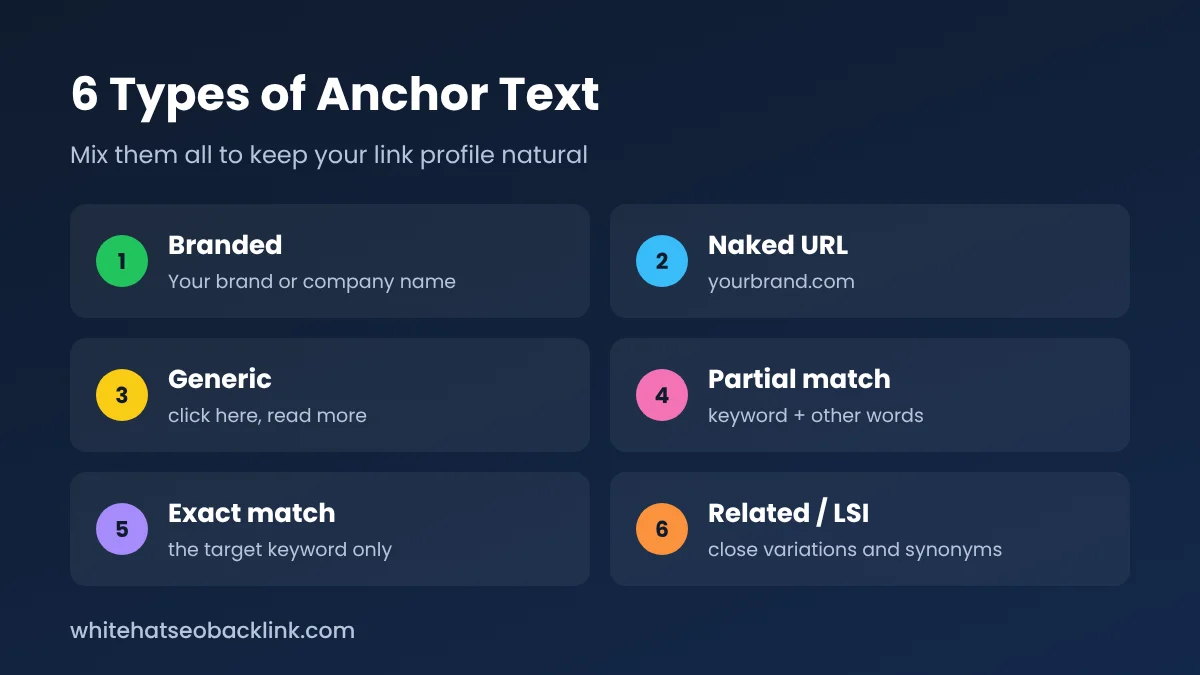
The 6 types of anchor text (with examples)
1. Branded anchors
Your brand or company name, like “Whitehat SEO Backlink” or “according to HubSpot”. These are the safest anchors you can get, and they should be the biggest group in your profile.
2. Naked URL anchors
The bare address, such as “whitehatseobacklink.com” or the full URL. They’re common in citations, forums, directories and resource lists.
3. Generic anchors
Phrases like “click here”, “this guide” or “learn more”. They carry little keyword value, but they make a profile look human.
4. Partial match anchors
Your keyword plus other words, for example “a practical guide to anchor text diversity”. You get a relevance signal with far less risk than exact match.
5. Exact match anchors
The target keyword and nothing else. This is the strongest relevance signal, and also the riskiest. Use it sparingly and only where it reads naturally.
6. Related (LSI) anchors
Close variations and synonyms, like “varying your link anchors” or “natural link profile”. They help Google connect your page to the wider topic. One more note: when an image is linked, its alt text works as the anchor, so image links count too.
What’s a safe anchor text ratio?
Google has never published an ideal ratio, so anyone promising you the “perfect” number is guessing. What actually works is simple: look at the pages already ranking for your keyword and stay close to their pattern. When we start a campaign and don’t have competitor data yet, we use this benchmark:
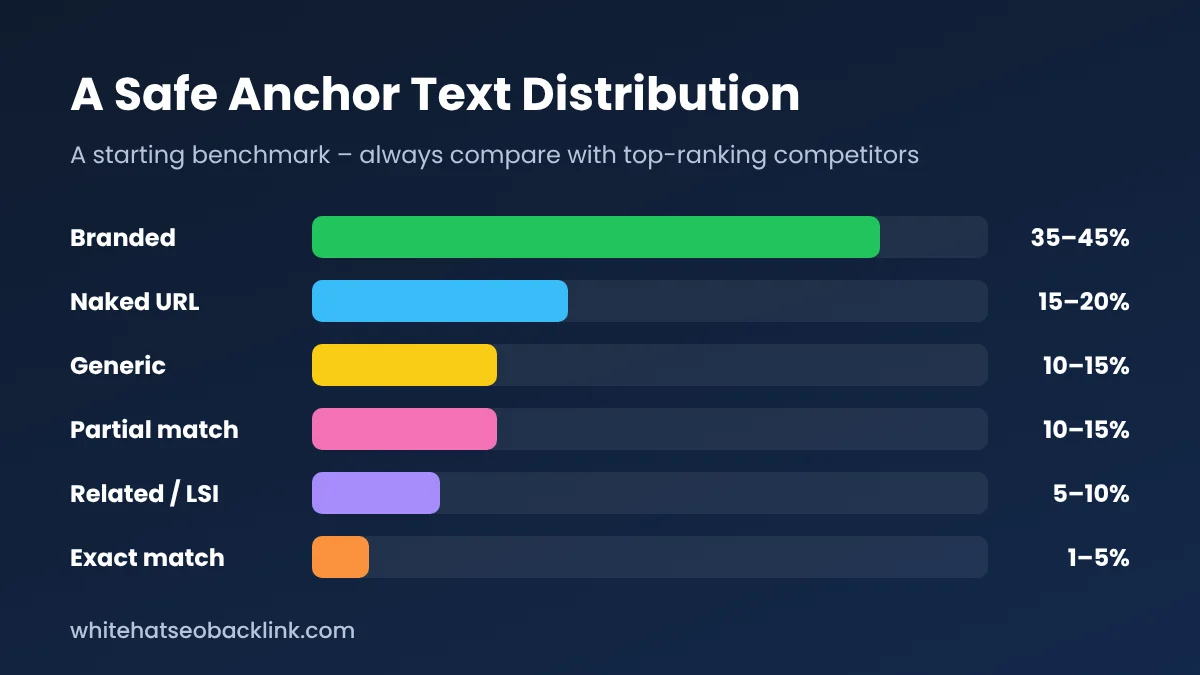
- Branded: 35–45%
- Naked URL: 15–20%
- Generic: 10–15%
- Partial match: 10–15%
- Related / LSI: 5–10%
- Exact match: 1–5%
A few adjustments are worth making:
- New websites: keep exact match closer to 1–2% and lean heavily on branded anchors until you have some history.
- Exact-match domains: if your brand name contains your keyword, your branded anchors are also keyword anchors, so be extra careful.
- Local businesses: brand plus city anchors, like “Smith Dental Austin”, are natural and safe.
Also, check anchors per page, not just site-wide. Your homepage will naturally collect branded links, while blog posts attract topic-related anchors. A single service page with 20 exact-match links is a red flag even if your site-wide numbers look fine.
Natural vs over-optimized: spot the warning signs
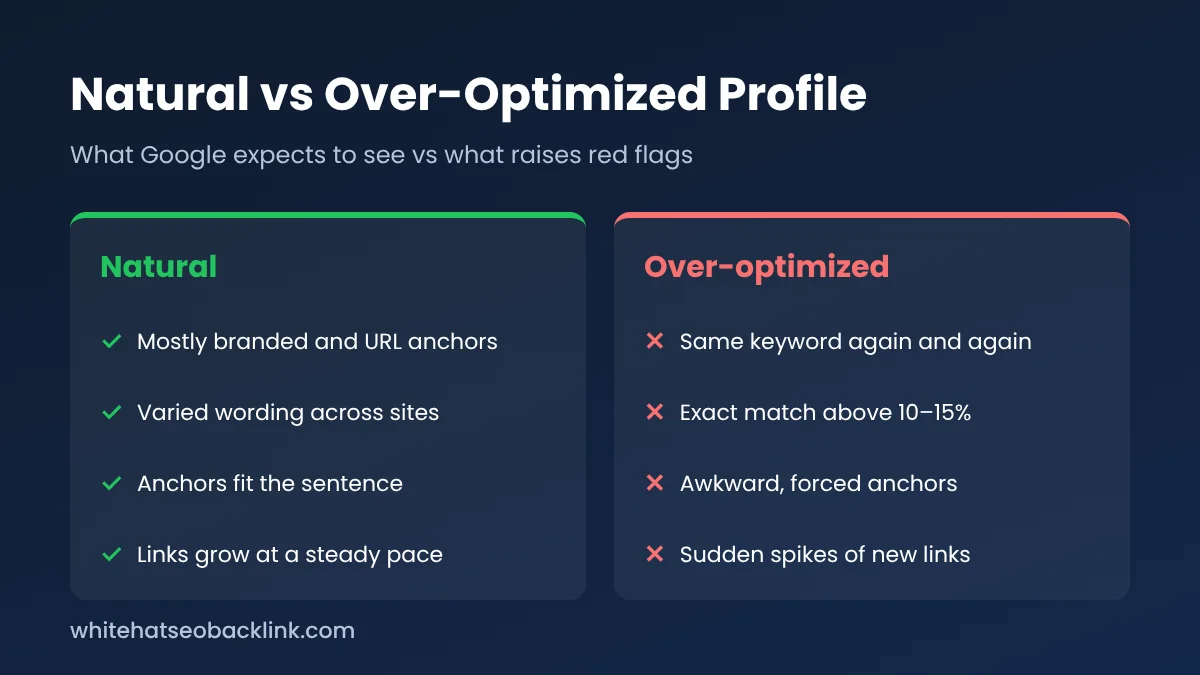
Watch out for these patterns in your backlink report:
- One money keyword dominates your top anchors.
- Exact match makes up more than 10–15% of links to a single page.
- Anchors that don’t fit the sentence, like “For best cheap SEO services USA visit us”.
- The same anchor repeated across many unrelated sites.
- A sudden spike of keyword-heavy links in a few weeks.
- Site-wide footer or sidebar links with keyword anchors.
If you recognize three or more of these, run the audit below before building another link.
How to audit your anchor text in 4 steps
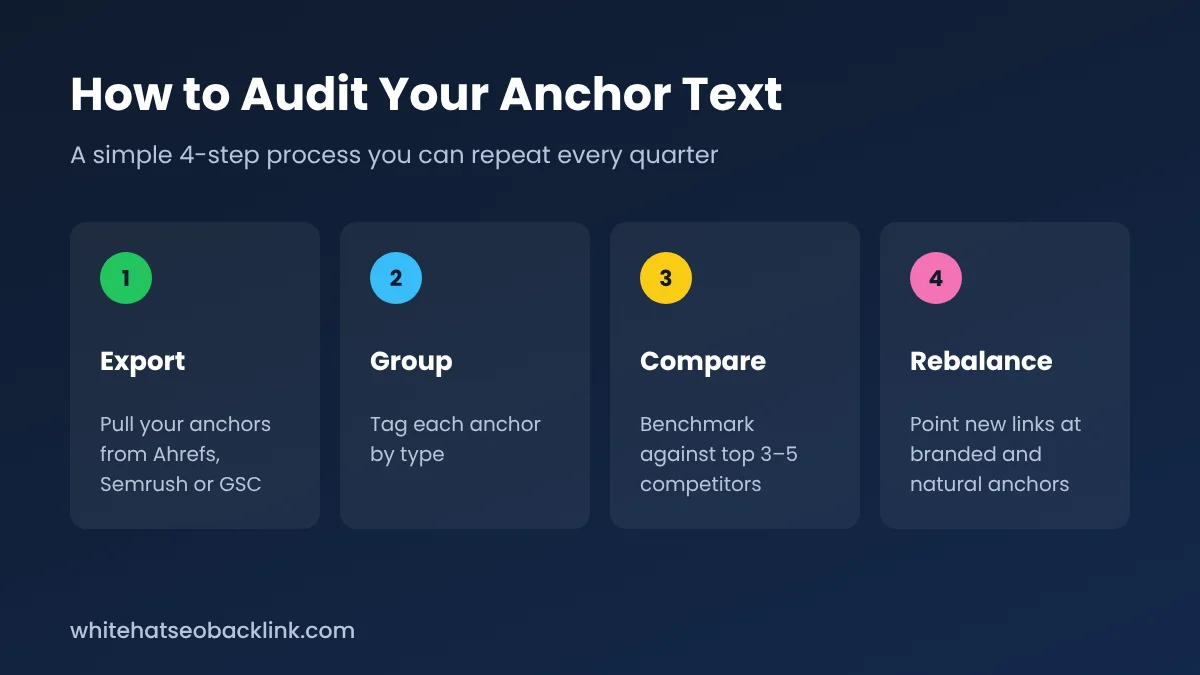
Step 1: Export your anchors
Use the Anchors report in Ahrefs Site Explorer or Semrush Backlink Analytics. If you don’t pay for a tool, Google Search Console shows your top linking text for free under Links.
Step 2: Group each anchor by type
Paste the list into a spreadsheet and tag every anchor with one of the six types above. Count by referring domains, not total backlinks, because one site-wide link can inflate the numbers by thousands.
Step 3: Compare with competitors
Repeat the same exercise for the top 3–5 pages ranking for your main keyword. Their average mix is your most realistic target, much more reliable than any generic ratio.
Step 4: Rebalance with new links
Don’t delete good links just to fix a percentage. Instead, dilute the problem by pointing new links at branded, URL and natural anchors. Ask site owners to change an anchor only when it is clearly spammy, and save the disavow file for links that are truly toxic.
Not sure what you’re looking at? Request a free link analysis and we’ll review your backlink profile with you.
7 rules for building anchor text diversity naturally
- Let the content choose the anchor. Write the sentence first, then link the words that already fit.
- Make branded anchors your default for guest posts, author bios and PR mentions.
- Save exact match for your best placements, such as a highly relevant, authoritative site, and use it rarely.
- Spread links across pages. Link to deep pages and blog posts, not only your homepage.
- Use partial and related phrases for contextual links. They suit niche edits especially well. Not sure which link type fits? Compare niche edits vs guest posts.
- Build at a steady pace. Ten links a month beats fifty in one week and nothing after.
- Vet the site, not just the anchor. A perfect anchor on a junk site is still a junk link. Use our guest post site quality checklist and focus on relevant backlinks.
Common anchor text mistakes to avoid
- Using the same anchor in every guest post you publish.
- Trusting a “perfect” ratio from a blog post (including this one) over real competitor data.
- Buying cheap link packages that promise keyword-rich anchors.
- Panic-disavowing good links because of one bad month.
- Forgetting internal links. Internal anchors carry far less risk, but they should still be descriptive and read naturally.
Final thoughts
Anchor text diversity isn’t about hitting a magic percentage. It’s about making your link profile look like what it should be: a real business that people mention in their own words. Get the mix right, keep building relevant links at a steady pace, and your rankings become much harder to shake. For the bigger picture, work through our off-page SEO checklist.
Prefer to have experts handle it? Our link building packages use varied, natural anchors on real, relevant websites.
Frequently asked questions
What is a good anchor text ratio?
A safe starting point is roughly 35–45% branded, 15–20% naked URL, 10–15% generic, 10–15% partial match, 5–10% related and 1–5% exact match. Always adjust it based on what top-ranking competitors in your niche look like.
Can exact match anchor text hurt my rankings?
Yes, if you overuse it. A handful of exact-match links on relevant sites is normal. A profile where the same keyword dominates can trigger algorithmic filters or a manual action for unnatural links.
Does internal link anchor text need to be diverse?
Not in the same way. Internal links carry much less risk, and descriptive keyword anchors are fine. Just keep them natural and helpful for readers.
How often should I check my anchor text profile?
Once a quarter is enough for most sites. Also check after any big link building campaign or a sudden ranking drop.
Do nofollow links count toward anchor text diversity?
They are part of a natural profile, and most SEO tools include them in anchor reports. Since Google treats nofollow as a hint, focus your risk checks on followed links, but don’t worry about having nofollow links in the mix. They’re a sign of a normal profile.