How to Check Guest Post Site Quality: A 9-Point Checklist
Finding sites that accept guest posts is easy. Search “write for us” plus your niche and you will get hundreds of them. Knowing how to check guest post site quality is the harder part, and it is where most link building budgets are lost.
A bad guest post site will happily take your money, publish your article next to posts about casinos and CBD gummies, and leave you with a link that Google ignores. This guide shows you how to vet a site before you pitch, pay or write a single word, using checks you can do yourself in about ten minutes per site.
Why domain authority alone is not enough
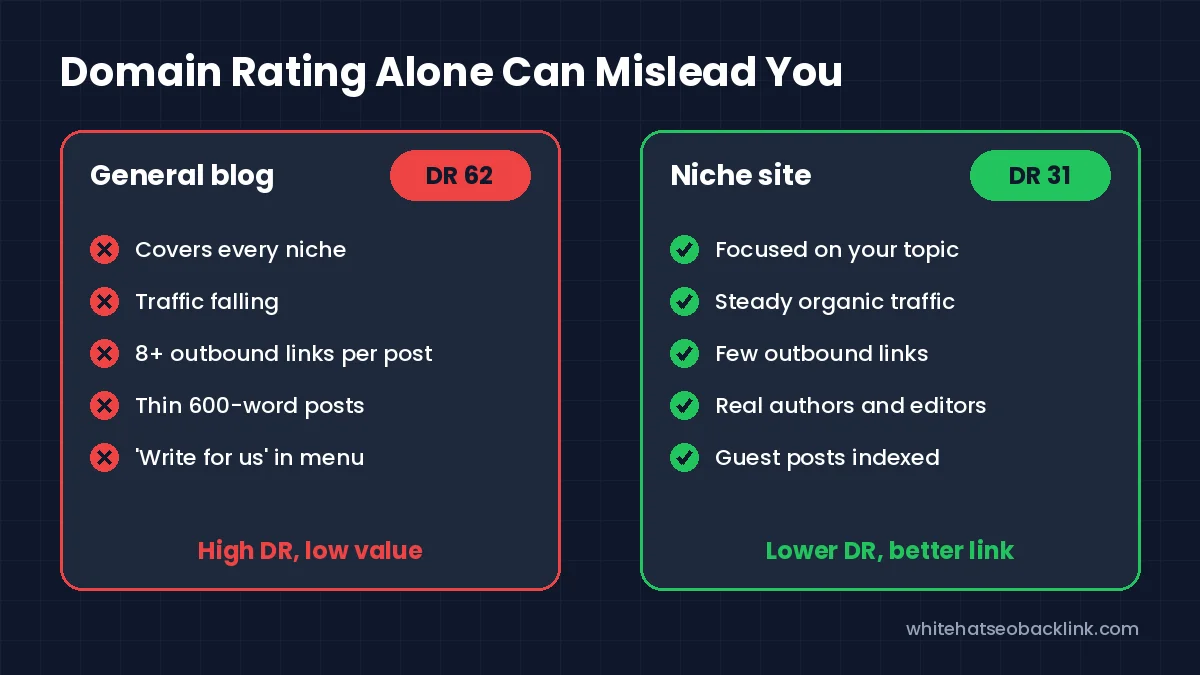
Most people start and stop at one number: DA, DR or Authority Score. The problem is that these are third-party metrics, and they are easy to inflate. A site can buy a few strong links, push its DR to 50, and then sell guest posts to anyone who filters by DR alone.
Use authority metrics as a first filter, not a final answer. As we explain in our guide on how relevant backlinks improve your website’s authority, topic fit usually matters more than the score. A DR 30 site with steady organic traffic and content that matches your niche is usually a better home for your link than a DR 60 site that publishes anything for a fee.
A 9-point checklist to vet any guest post site
1. Check the organic traffic trend, not just the number
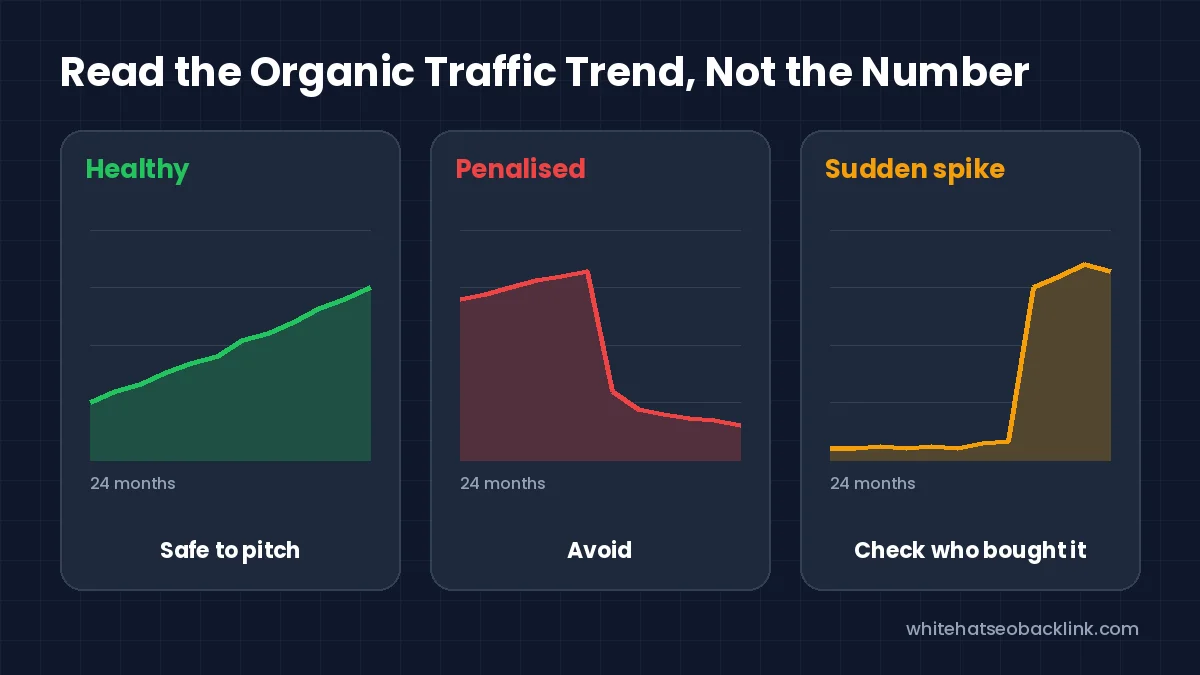
Open the site in Ahrefs, Semrush or a similar tool and look at the traffic graph for the last one to two years. You want a line that is flat or rising. A sharp cliff usually means the site was hit by a Google update, and links from a penalised or devalued site are not worth much.
Also watch for the opposite: a sudden spike from nothing. That can point to a site that was recently bought, rebuilt and turned into a link seller.
2. See which keywords bring the traffic
Traffic only matters if it is relevant. Look at the site’s top ranking keywords. A marketing blog should rank for marketing terms. If a “business” site gets most of its visits from celebrity net worth posts or random tool pages, its audience has nothing to do with yours.
3. Check where the traffic comes from
Look at the country split. If you sell to customers in the US and 90% of the site’s visitors are from a country you don’t serve, the link may still pass some value, but you lose most of the referral and brand benefit.
4. Read the last 20 posts
This is the check most people skip, and it is the one that catches the most bad sites. Scroll through recent articles and ask:
- Do the topics stick to one area, or does the site cover everything?
- Does almost every post have one or two outbound commercial links?
- Do posts read like they were written for people, or just to hold a link?
- Are there real authors with real bios, or the same generic “admin” on everything?
A site where every post is a thin 600-word article built around a dofollow link is a link farm, whatever its metrics say.
5. Look for the “write for us” footprint
Accepting guest posts is normal. Advertising it everywhere is a warning sign. If the site has “write for us”, “sponsored post” or “guest post price” pages linked from the main menu, it probably sells links to anyone. Google’s link spam policies also name large-scale guest posting campaigns as a problem, so sites built around them carry real risk. Some sites also add a “sponsored” or “contributed” tag to every guest article, which can reduce the value of the link.
6. Check outbound links per page
Open a few guest articles and count the external links. A good article links out where it helps the reader. A post with eight external links to unrelated commercial sites is being sold several times over, and each link gets a smaller share of whatever value the page has.
7. Confirm the site is indexed properly
Search site:example.com in Google. If far fewer pages show up than the site actually has, or the guest posts in particular do not appear, Google may not be indexing that content. A link on an unindexed page does nothing.
8. Look at the site’s own backlink profile
You are buying a link from this site, so check who links to it. If its backlinks are mostly from spammy directories, comment sections, foreign-language link networks or other obvious guest post sellers, its authority is built on sand.
9. Make sure the site is a real business or publication
Real sites have an about page with real people, a way to contact them, social profiles with some activity, and a reason to exist beyond selling links. If you can’t tell who runs it or why, move on.
Red flags that mean “walk away”
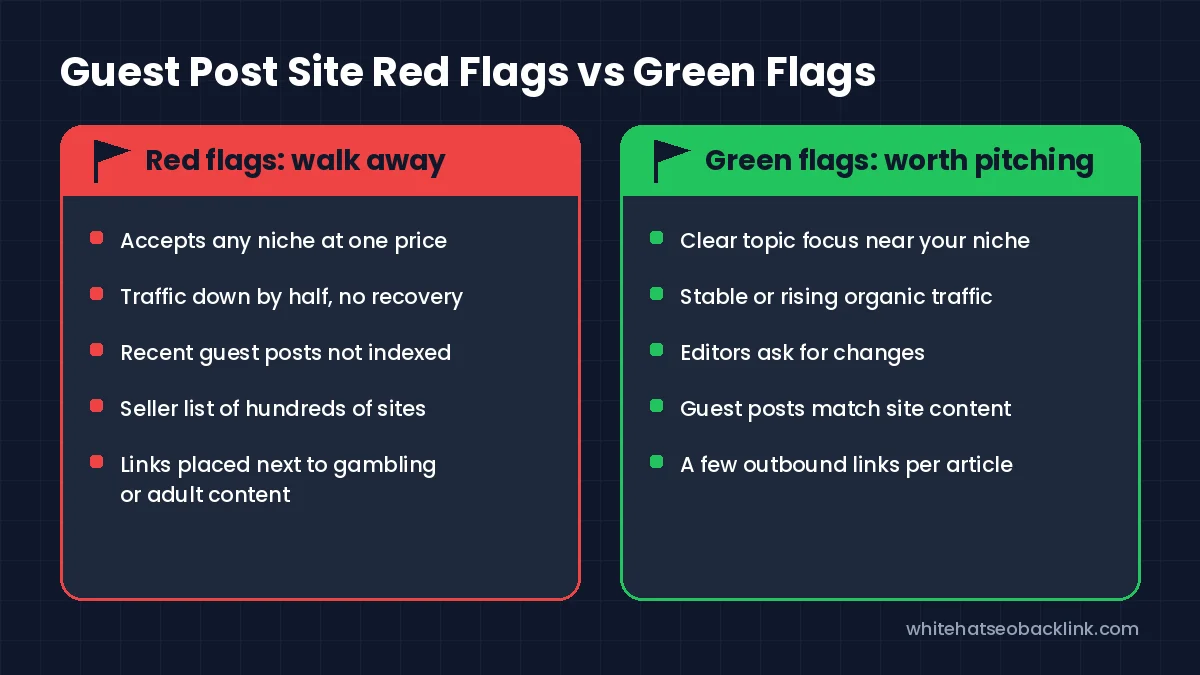
- The site accepts any niche in the same price list.
- Organic traffic has dropped by more than half and not recovered.
- Recent guest posts are not indexed in Google.
- The seller has a spreadsheet of hundreds of sites at the same price.
- Your link has to go in an article about gambling, adult or crypto content when you are not in those industries.
- The site guarantees “permanent dofollow” links but refuses to show examples.
Green flags of a good guest post site
- A clear topic focus that overlaps with your niche.
- Stable or growing organic traffic from relevant keywords.
- Editors who ask for changes rather than publishing whatever you send.
- Guest articles that look and read like the rest of the site’s content.
- A modest number of outbound links per article.
Strict editors can feel like an obstacle when you are trying to get a link live. In practice, a site that rejects weak content is exactly the kind of site whose links are worth having.
How to find better guest post sites than your competitors
Most of your competitors are pulling from the same “write for us” search results and the same seller lists. That is why so many link profiles in a niche look identical. A few ways to get ahead:

- Reverse-engineer the sites ranking above you. Pull their backlinks, filter for in-content links from real blogs, and note which sites appear for more than one competitor. Those sites already link in your niche and are likely to accept a strong pitch.
- Look for sites that don’t advertise guest posts. Many good blogs accept contributions but never publish a “write for us” page. A personal, specific pitch to the editor works far better than a template.
- Go one step sideways in your niche. A dental clinic does not only need dental sites. Health, family and local business sites can be just as relevant, and they are usually less saturated.
- Pitch topics the site is missing. Check what the site already covers and offer something it doesn’t have. Editors say yes far more often when you fill a gap.
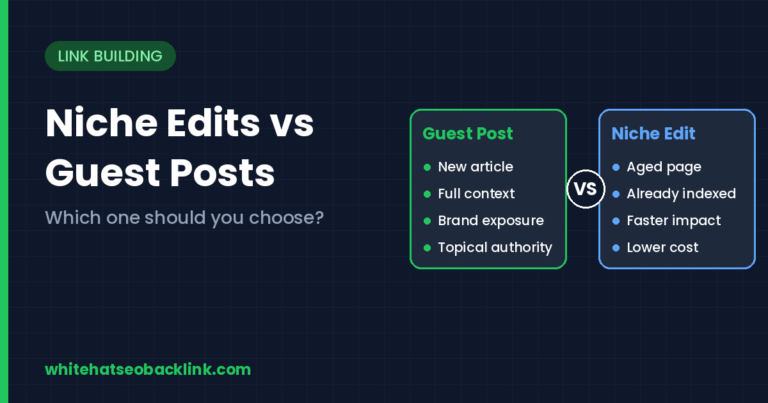
If you are still deciding whether guest posts are the right fit for your campaign at all, our comparison of niche edits vs guest posts explains when each one makes more sense.
Frequently asked questions
What DR should a guest post site have?
There is no magic number. Many agencies use DR 30 to 40 as a starting filter, but relevance and real traffic matter more. A smaller site that is focused on your exact topic can outperform a bigger general site.
How can I tell if a site sells links?
Signs include a public price list, a menu link to write for us or sponsored posts, a wide mix of unrelated topics, and articles that each contain one or two commercial links with little other purpose.
Is it bad if a guest post link is nofollow?
A nofollow link passes less ranking value, but it is not worthless. It can still send traffic and adds natural variety to your profile. Just make sure you know what you are getting before you pay for it.
How many guest posts do I need to rank?
It depends on how strong the pages already ranking are. Checking your competitors’ referring domains for the same keyword gives you a realistic target, rather than a generic number.
Final thoughts
Vetting takes longer than buying from a list, but it is the difference between links that move rankings and links that sit there doing nothing. Check traffic and its source, read the content, look at outbound links and confirm indexing. If a site passes all of that, it is worth your best article. Once you know how to check guest post site quality, each new site takes less time to review.
Don’t have time to vet sites yourself? Our guest post link building service only uses DR 40+ sites with real organic traffic, and you can start with a free link analysis to see where your profile stands against your competitors.