Niche Edits vs Guest Posts: Which One Should You Choose?
If you have spent any time shopping for links, you have run into the same question we hear on almost every sales call: niche edits vs guest posts, which one should I buy? Both put a link to your site on someone else’s website. Both can work. Both can also be a waste of money if they are done badly.
The honest answer is that neither one is “better” across the board. They solve different problems. This guide explains how each one works, where each one wins, and how to decide which to use for the page you are trying to rank.
What is a guest post?
A guest post is a brand new article, written for another website and published on it, with a link back to your site somewhere in the content. The host site gets free content for its readers. You get a contextual link and a mention of your brand in front of a relevant audience.
Because the article is new, you control the angle. You can pick a topic that sits right next to the page you want to rank, write the surrounding paragraph so the link makes sense, and choose anchor text that reads naturally. The trade-off is time. The article has to be pitched, written, edited, approved and then indexed by Google before the link starts doing anything.
What is a niche edit?
A niche edit (also called a link insertion or curated link) is a link added to an article that already exists on another site. Nobody writes a new post. Instead, the site owner updates an older page, usually by adding a sentence or editing an existing one, so that it links to your resource.
The appeal is that the page is already indexed, often already ranking, and may already have its own backlinks pointing to it. A link from that page can start passing value sooner than a link on a page Google discovered yesterday. The downside is that you have far less say over the content around your link, and the quality of the host page varies a lot.

Niche edits vs guest posts: the key differences
| Factor | Guest post | Niche edit |
|---|---|---|
| Content | New article written for the host site | Link added to an existing article |
| Page age | Brand new, needs to be crawled and indexed | Aged, already indexed |
| Speed of impact | Slower, usually weeks | Often faster, since the page already has history |
| Control over context | High: you shape the topic and the paragraph | Limited: the link must fit content someone else wrote |
| Brand exposure | Author bio, a full article about your topic | A single mention inside another article |
| Main risk | Low-quality “write for us” sites that publish anything | Links squeezed into irrelevant or hacked pages |
When guest posts are the better choice
Guest posts make the most sense when you need relevance more than speed.
- You are building topical authority. If you want Google to see your site as a source on a subject, a series of articles on related sites, each linking to a matching page on yours, sends a clear signal about what you cover.
- Your niche has few existing pages to edit. In narrow industries there may simply be no aged article on the right topic. Writing one is the only way to get a link with real context.
- You care about the reader seeing your brand. A good guest post can send referral traffic and leads, not just link equity. A niche edit rarely does that at the same level.
- You need to control anchor text carefully. When you are already close to over-optimised on exact-match anchors, writing the sentence yourself lets you use branded or partial-match anchors that still read naturally.
When niche edits are the better choice
Niche edits tend to win when you need movement on a page that is already close to ranking.

- Your page is sitting on page two. A link from an established page on the same topic can be the push that moves it onto page one.
- You are working with a tight timeline. There is no writing or approval cycle for a new article, so turnaround is usually shorter.
- The host page already has traffic and links. Some of that page’s existing strength flows through your link from day one.
- You want a natural-looking link profile. Real sites update old posts all the time. A mix of links on aged pages and new pages looks more like how links are earned in the wild.
The risks people don’t mention
Most of the damage in link building does not come from picking the “wrong” type. It comes from buying either type from the wrong place.
With guest posts, the risk is sites that exist only to sell posts. They accept any topic, from crypto to dentistry, and their content is written for search engines rather than readers. Google is good at spotting these patterns. Its spam policies specifically mention large-scale guest posting campaigns with keyword-rich anchor links, and links from these sites tend to be ignored at best.
With niche edits, the risk is placement. A link shoved into a 2019 article about something unrelated, or added to a page that gets zero visits, will not move anything. There is also a darker side: some sellers place links on hacked sites without the owner knowing, and those links disappear the moment the owner notices.
Whichever you choose, the same checks apply. Look at whether the site has real organic traffic, whether its other content matches your niche, and whether the page your link sits on is something a human would actually read. If you want a full checklist, our guide on how to check guest post site quality walks through it step by step. Relevance matters more than any single metric, which we explain in detail in how relevant backlinks improve your website’s authority.
Can you use both? (Yes, and you usually should)
For most sites, the strongest approach is a mix. A practical way to split it:
- Use guest posts to support your main service or category pages and build topical relevance over months.
- Use niche edits to push specific pages that already rank between positions 8 and 20.
- Point some links at supporting blog posts, not just money pages, and let internal links carry that value to the pages that convert.
- Vary anchor text. Lean on branded and natural anchors, and keep exact-match anchors to a small share of the total.
Spreading links this way also lowers your risk. If one type of link stops working as well after an algorithm update, the whole campaign does not collapse with it.

How to decide for your next campaign
Ask three questions before you spend anything:
- How close is the target page to ranking? Close: start with niche edits. Far away or brand new: start with guest posts.
- How much time do you have? If results are needed this quarter, niche edits on aged pages usually move faster.
- What do your competitors’ links look like? Pull the backlinks of the pages ranking above you. If they are built mostly on in-content links from aged articles, that tells you what is working in your niche.
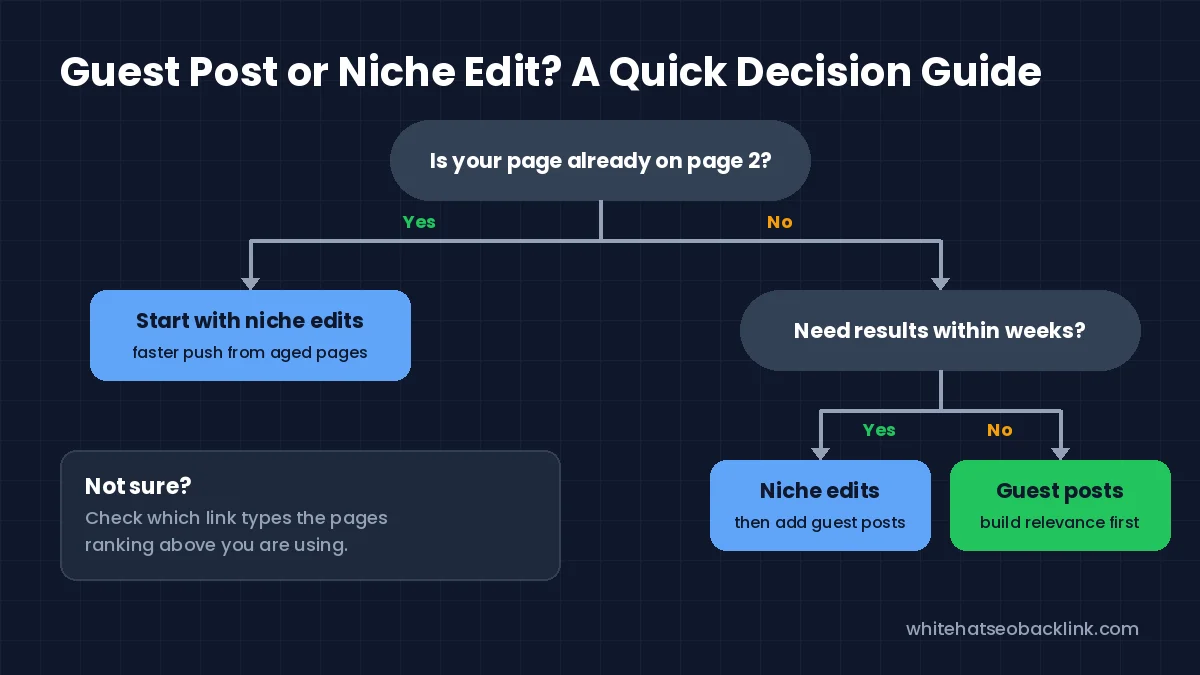
That last step is often the most useful, and it is something we do before every campaign. If you would like a second opinion, you can request a free link analysis and we will look at your profile and your top competitors and tell you which mix makes sense for you.
Frequently asked questions
Are niche edits safe?
They are as safe as the site they are placed on. A niche edit on a relevant, well-maintained site with real traffic is no different from a link the site owner added on their own. A niche edit on a hacked or spammy page is a liability.
Do guest posts still work in 2026?
Yes, when they are published on real sites in your niche and written for that site’s readers. What stopped working years ago was mass guest posting on sites that publish anything for a fee.
Which is cheaper, a guest post or a niche edit?
Niche edits are often cheaper because no new article needs to be written, but pricing depends far more on the quality of the host site than on the link type. A cheap link on a weak site is still expensive if it does nothing.
How long do niche edits and guest posts take to show results?
Niche edits on indexed pages can start to show an effect within a few weeks. Guest posts usually take longer because the new page has to be crawled, indexed and build some history of its own. Exact timing depends on your competition and how strong the rest of your site is.
The bottom line
Guest posts build relevance and brand visibility. Niche edits deliver faster, page-level pushes from content that already has history. In the niche edits vs guest posts debate, choosing between them is less important than choosing good sites, keeping your anchors natural, and building links to the pages that need them most. Get those three things right and either link type will pull its weight.