Niche Edits: What They Are, Are They Safe and How to Earn Them the White Hat Way
If you have looked into link building for more than five minutes, someone has offered you niche edits. They promise fast results, links on aged pages and no need to write new content. But are they safe, or just a faster way to get a Google penalty?
This guide explains what niche edits are, how they compare with guest posts, what they really cost and how Google sees them. Most importantly, it shows five white hat ways to earn the same kind of link without breaking Google’s rules.
What are niche edits?
Niche edits, also called link insertions or curated links, are links added to articles that already exist and are already indexed. Instead of publishing a new guest post, the site owner edits an old post and inserts a link to your page, usually with a sentence or two of new text around it.
The appeal is simple. The page already has age, authority and sometimes backlinks of its own. A link from that page can pass value quickly, often faster than a link on a brand-new guest post.
Niche edits vs guest posts

| Factor | Link insertion | Guest post |
|---|---|---|
| Content | Existing article | New article |
| Page age | Months or years | Brand new |
| Effort | Low | Medium to high |
| Brand exposure | Low | Medium to high |
| Risk if paid | High | High |
Both methods carry the same core risk: if you pay for a link that passes PageRank, it breaks Google’s spam policies. The format does not change that.
Are niche edits safe?
It depends on how you get them.
Paid niche edits are links bought from a seller or site owner. Google’s spam policies list buying or selling links that pass ranking credit as a link scheme. Google’s SpamBrain system is trained to spot these patterns, and many of the sites selling insertions have since lost most of their traffic. The risk is real: links may be ignored at best, or lead to a manual action at worst.
Earned niche edits are a different story. If an editor adds your link to an existing article because it genuinely helps readers, that is a natural editorial link. That is completely white hat, and it is how good outreach has always worked.
So the question is not whether niche edits are good or bad. The question is whether the link was bought or earned.
What do niche edits cost?

Paid link insertion prices range from very cheap to several hundred dollars per link. Cheap offers are almost always from link farms. Higher prices do not guarantee safety either; they just mean the seller has better-looking metrics. For a full breakdown of the market, see how much link building costs.
Earned insertions cost time instead of money: research, a well-written email and follow-up. In our experience, a skilled outreach person can earn a quality insertion in a few hours of work.
Red flags in niche edit offers
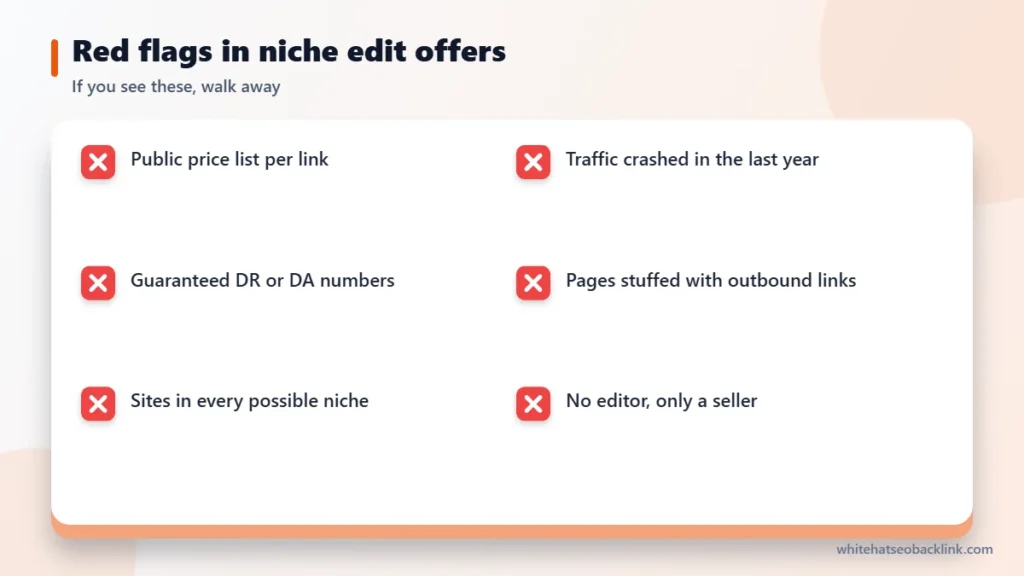
If a seller emails you with a list of sites and prices, check for these warning signs. Any one of them is reason to say no.
- A price list with fixed rates per link and per domain rating.
- Guaranteed metrics like “DA 50+” instead of real traffic.
- Sites covering every topic from crypto to cooking.
- An organic traffic graph that dropped sharply in the past year.
- Target pages already stuffed with commercial outbound links.
- No editor or real person behind the site, only a sales contact.
5 white hat ways to earn link insertions
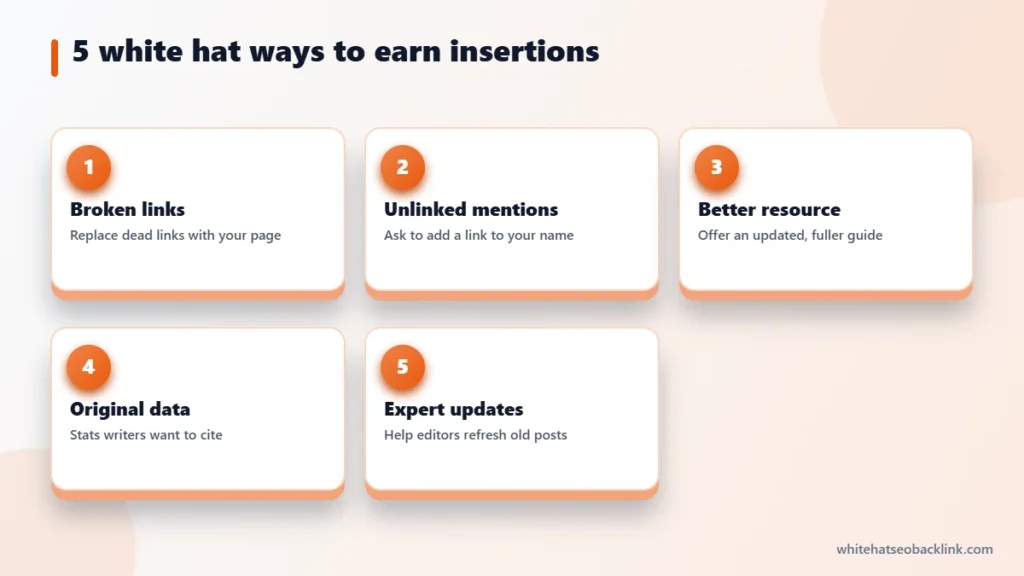
These methods get you the same benefit as a paid insertion, a link on an aged, relevant page, without paying for it.
1. Broken link building
Find dead links on relevant pages, then suggest your page as a replacement. Editors like this because you are helping them fix their site. Our step-by-step broken link building guide shows how to find these pages.
2. Unlinked brand mentions
Search for pages that mention your brand, product or founder but do not link to you. A short, friendly email asking for a link has a high success rate. See unlinked brand mentions for scripts.
3. The better resource pitch
Find popular articles that link to an outdated resource, such as a guide from 2019 or a tool that no longer exists. Show the editor your newer, more complete version and suggest an update.
4. Original data and stats
Writers love citing numbers. Publish a small survey, a data study or useful statistics in your niche. Then contact authors of articles that discuss the topic but use old or missing data.
5. Help editors update old posts
Many sites refresh their best posts every year. Offer a useful expert quote, a new section idea or a fixed fact. In return, editors often credit you with a link. This is the most natural form of niche edits.
How to pitch a link insertion
Keep your email short and focused on the reader:
- Mention the specific article by name and what you liked about it.
- Point out the exact spot where your page fits, or the broken or outdated link.
- Explain in one sentence why your page helps their readers.
- Make it easy: give the URL and suggest anchor text, but let them decide.
- Follow up once after five to seven days, then move on.
Never offer payment for a dofollow link. If a site asks for money, the link should be marked rel=”sponsored” to stay within Google’s rules. More tips are in our link building outreach email guide.
How to judge a page before you pitch
- The page is relevant to your topic and ranks for real keywords.
- The site has steady or growing organic traffic.
- The page links out to only a few other sites.
- Your link would genuinely improve the article for readers.
FAQs
Do niche edits still work in 2026?
Earned niche edits work well because they are natural editorial links. Paid ones are risky: Google may ignore them or penalise the site, and many seller networks have lost their value.
Are niche edits better than guest posts?
Neither is better in itself. Earned links from either method are valuable. Guest posts usually bring more brand exposure, while earned insertions place your link on pages that already have authority.
How can I tell if a niche edit was paid?
Common signs are sites with price lists, unrelated topics, sudden traffic drops and pages full of commercial links. If the link was added only because money changed hands, it is a paid link.
What anchor text should I use?
Use natural anchors like your brand name, the page title or a descriptive phrase. Avoid exact-match commercial anchors. Our guide to anchor text diversity explains the safe mix.
Final thoughts
Niche edits are not a magic shortcut. Bought links on existing posts carry the same risk as any paid link scheme. But the core idea, getting your link added to a strong, relevant article, is smart. Earn those insertions with broken links, brand mentions, better resources and real data, and you get the benefits without the risk.