How Many Backlinks Do I Need to Rank? A Simple Way to Find Your Number
“How many backlinks do I need to rank?” is one of the first questions every site owner asks. It is also one of the hardest to answer with a single number, because the right answer for a local bakery is very different from the right answer for a credit card comparison site.
The good news: you don’t need to guess. The pages already sitting on page one tell you almost everything. In this guide you’ll learn why there is no fixed number, which factors move the target up or down, and a simple 5-step method to work out your own number for any keyword.
The short answer
There is no fixed number of backlinks that guarantees a ranking. The number you need depends on how many quality links the pages already ranking have earned.
A practical rule: look at the top 5 results for your keyword, count their referring domains (unique websites linking to them), and aim to get close to the middle of that range with links of similar or better quality. For low-competition, long-tail keywords that can be as few as 0 to 10 links. For competitive money keywords it can be hundreds.
Backlinks are not a score you hit once. They are the gap between you and the pages above you.
Why there’s no magic backlink number
Google uses links as one signal among many. A page with 20 strong, relevant links can outrank a page with 500 weak ones. That’s why two people asking the same question get completely different answers.
Here is what changes the number for you:
- Keyword competition. “Best running shoes” and “best running shoes for flat feet over 50” are very different fights.
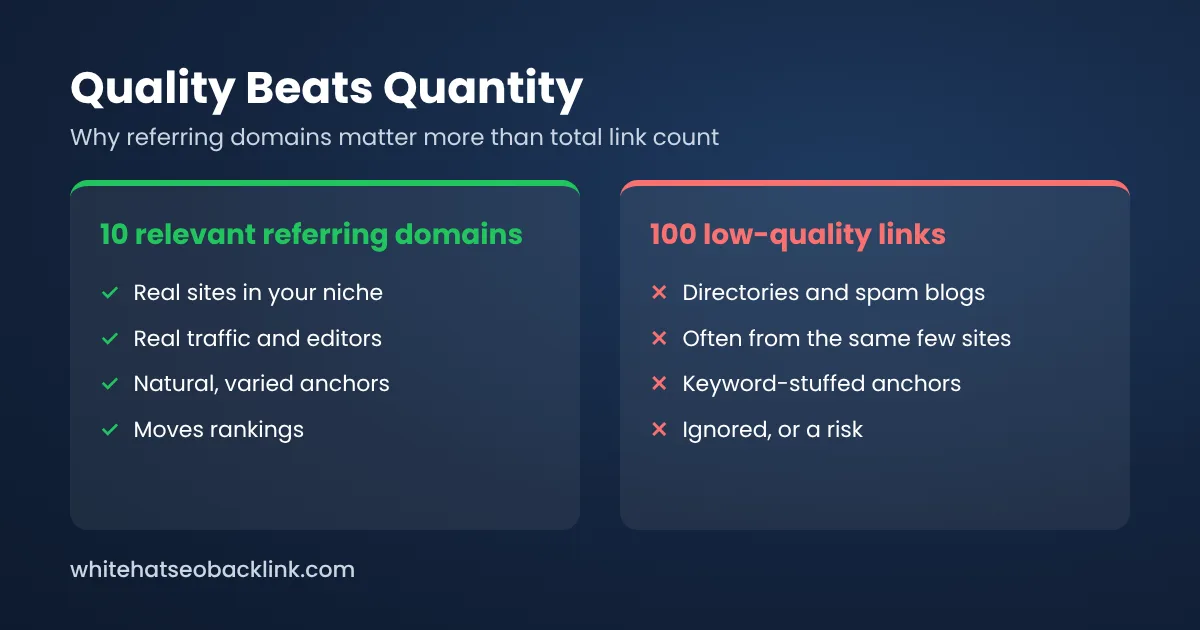
- The quality of competing links. Ten links from respected industry sites beat a hundred from random directories.
- Your site’s overall authority. A site with a strong link profile often ranks new pages with few or no links pointing to that exact page.
- Content quality and search intent. If your page doesn’t answer the query better than the others, links alone rarely push it up.
- Internal links. Pages you link to well from inside your own site pass authority, which reduces how many external links you need.
Referring domains matter more than total backlinks
When people say “backlinks” they usually mean the total count of links. That number is easy to inflate. One website can link to you 300 times from a sidebar or footer, and it still counts as just one site vouching for you.
That’s why most SEOs look at referring domains first. Ten links from ten different, relevant websites are worth far more than ten links from the same site.
| Metric | What it counts | How useful it is |
|---|---|---|
| Total backlinks | Every individual link pointing to a page | Easy to inflate, can mislead |
| Referring domains | Unique websites linking to a page | Much better benchmark |
| Linking page quality | Traffic, topic and authority of linking pages | What actually moves rankings |
If you want a deeper look at why the topic of the linking site matters, read our guide on how relevant backlinks improve your website’s authority.
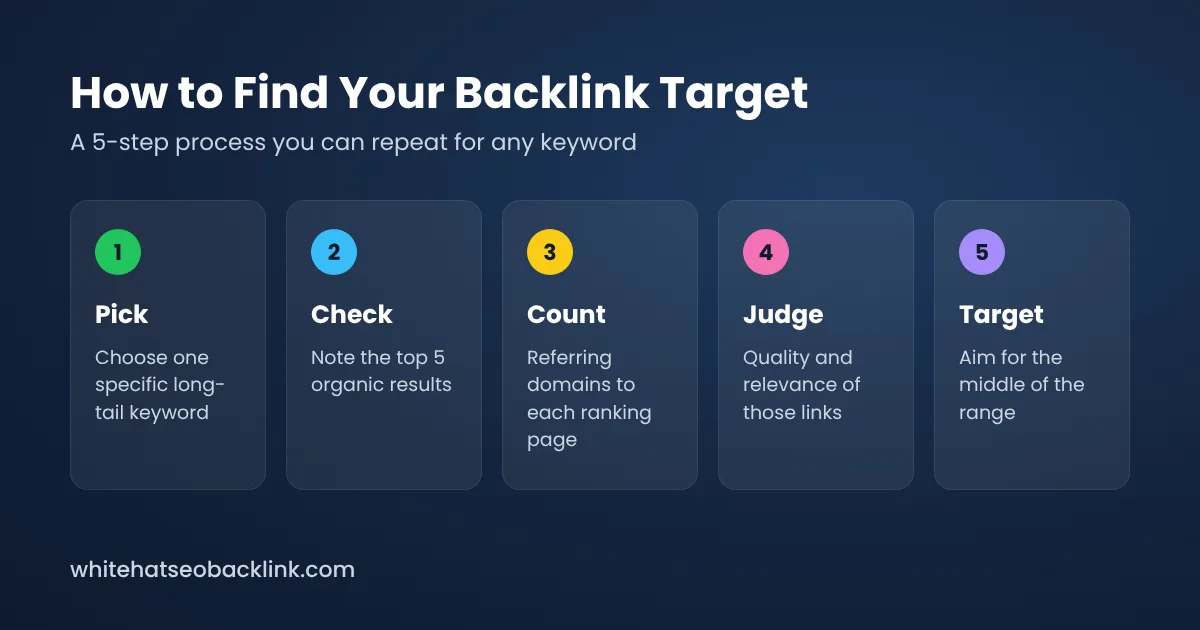
How to find how many backlinks you need in 5 steps
Step 1: Pick one specific keyword
Do this per keyword, not per website. Choose the main keyword for the page you want to rank. Long-tail keywords (three or more words with a clear intent) are usually the easiest place to start.
Step 2: Look at the top 5 ranking pages
Search the keyword in Google (use an incognito window) and note the top 5 organic results. Skip ads, maps and video results. These pages are your real competition, not the big brand you think of first.
Step 3: Count each page’s referring domains
Put each URL into a backlink tool such as Ahrefs, Semrush or Moz and note the referring domains to that page, not the whole site. Write them in a simple sheet like this:
| Position | Page referring domains | Site authority |
|---|---|---|
| #1 | 42 | High |
| #2 | 18 | Medium |
| #3 | 25 | High |
| #4 | 9 | Medium |
| #5 | 12 | Low |
In this example the middle of the range is around 18 referring domains. That’s your first target.
Step 4: Judge the quality, not just the count
Open a few of the linking sites for each competitor. Are they real, topic-related websites with traffic? Or thin blogs and directories? If a competitor’s 40 links are mostly low quality, you may beat it with far fewer good ones. Our guest post site quality checklist shows exactly what to look for.
Step 5: Set your target and work backwards
Use the middle of the range as your target, then adjust:
- If your site is newer or weaker than the competition, aim nearer the top of the range.
- If your site is already strong in this topic, you may need less.
- If your content is clearly better than what ranks now, links work harder for you.
Then plan how many links you can realistically build per month. If your target is 20 referring domains and you can earn 4 good ones a month, you’re looking at roughly 5 months of steady work.
Real examples: how the number changes by keyword
These are typical patterns, not fixed rules:
| Keyword type | Example | Typical referring domains on page one |
|---|---|---|
| Long-tail informational | “how to clean suede shoes with vinegar” | 0 to 10 |
| Local service | “emergency plumber in Leeds” | 5 to 30 (plus a strong Google Business Profile) |
| Mid-competition commercial | “best project management software for small teams” | 30 to 100 |
| Head term in a hard niche | “car insurance” | Hundreds to thousands |
This is why going after long-tail keywords first makes sense for newer sites. You can rank with a handful of good links, build traffic and authority, then move up to harder terms.
Keyword difficulty scores give you a quick estimate
Tools like Ahrefs show a keyword difficulty (KD) score from 0 to 100, based on the links pointing to the pages that rank. Ahrefs even shows a rough estimate of how many referring domains you’d need for the top 10.
Use KD as a shortcut to filter keywords, then do the 5-step check above before you commit. The tool gives you a guess. The top 5 results give you the real picture.
How long does it take for backlinks to work?
Most new links take a few weeks to a few months to show their full effect. Google has to crawl the linking page, process the link and re-evaluate your page. That’s normal, and it’s why steady link building works better than a big burst followed by nothing.
A sudden spike of links, especially with the same keyword-rich anchor text, can look unnatural. Keep your anchors varied. Our guide on anchor text diversity explains the safe mix.
How to get the links you need (the safe way)
Once you know your number, focus on links that real editors would place anyway:
- Guest posts on relevant sites with real traffic and a real audience.
- Niche edits (link insertions) inside existing, relevant articles. Not sure which to use? Compare niche edits vs guest posts.
- Linkable assets like original data, free tools or detailed guides.
- Digital PR and expert quotes for journalists and bloggers.
- Unlinked brand mentions turned into links with a friendly email.
For a full list of methods, see how to get backlinks with white-hat methods.
Mistakes that waste your link budget
- Chasing a number from a blog post. “You need 40 backlinks” is meaningless without the keyword. How many backlinks do I need to rank.
- Counting links instead of domains. Many links from one site rarely help much.
- Building links to a weak page. Fix the content and intent first.
- Ignoring internal links. Link to your target page from your strongest related pages.
- Buying cheap link packages. Spammy links can do nothing at best and cause problems at worst. Google’s spam policies are clear about link schemes.
Final thoughts
The honest answer to “how many backlinks do I need to rank?” is: as many quality referring domains as it takes to close the gap with the pages already ranking. Check the top 5, count their referring domains, judge their quality and set a target you can reach month by month.
Want someone to do the math for you? Get a free link analysis and we’ll show you the gap between your page and the top results, or check our link building packages when you’re ready to close it.
Frequently asked questions
Can I rank with zero backlinks?
Yes, for low-competition long-tail keywords it happens often, especially if your site already has some authority and the page answers the query well. For competitive keywords it is very unlikely.
How many backlinks per month is safe?
There’s no safe or unsafe number on its own. What matters is that the growth looks natural for your site and niche. A steady pace of quality links is safer than sudden spikes.
Do nofollow links count?
Google treats nofollow as a hint, so they can still help in some cases. They also bring referral traffic and make your profile look natural. Just don’t count on them to hit your target.
Should I build links to my homepage or inner pages?
Both. Homepage links build overall authority, while links to specific pages help those pages rank for their keywords. Most of your target number should point at the page you want to rank.