Unlinked Brand Mentions: How to Find Them and Turn Them Into Backlinks
Somebody wrote about your business. They named your brand, maybe even praised it. But they did not link to your website.
That is an unlinked brand mention, and it is one of the easiest link building wins you can get. The writer already knows you. They already like you enough to mention you. You are not asking a stranger for a favor. You are asking someone to finish what they started.
In this guide, you will learn how to find unlinked brand mentions, which ones are worth your time, how to ask for the link without sounding pushy, and what to do when the answer is no.
What Are Unlinked Brand Mentions?
An unlinked brand mention is any place online where your brand, product, founder or content is named but not linked to your site.
It can be a blog post that lists “great SEO agencies”, a news story that quotes your CEO, a forum thread that recommends your tool, or a podcast show notes page that names your company.
Google can understand brand mentions without links. But a real link does more. It passes authority, sends referral visitors and helps Google connect the mention to your actual website. That is why turning mentions into links is worth the effort.

Why Unlinked Mentions Are Easier Than Normal Outreach
Most outreach is cold. You email someone who has never heard of you and hope they care. Reply rates are often low.
Brand mention outreach is warm. The site owner has already:
- Heard of you
- Found you useful enough to write about
- Shown their readers your name
You are only asking them to make their own article more helpful for readers by adding a link they probably forgot. That is a small, fair request. It also keeps your link profile natural, because the link sits on a page that is already about you. If you want to understand why that matters, read our guide on how relevant backlinks improve your website’s authority.
The 4 Types of Mentions Most Guides Forget
Most articles only talk about your brand name. But there are four kinds of mentions you can turn into links:
- Brand name mentions. Your company or product name appears in the text.
- People mentions. Your founder, CEO or team members are quoted or named, but the site links to nothing or only to a social profile.
- Asset mentions. Someone used your image, chart, survey data or free tool and wrote “source: YourBrand” with no link.
- Misspelled mentions. People write your name wrong, add a space or drop a word. These hide from basic searches.
Asset mentions are often the best ones. When someone uses your data, they owe you a source credit. Asking for a link there is simply asking for proper attribution.
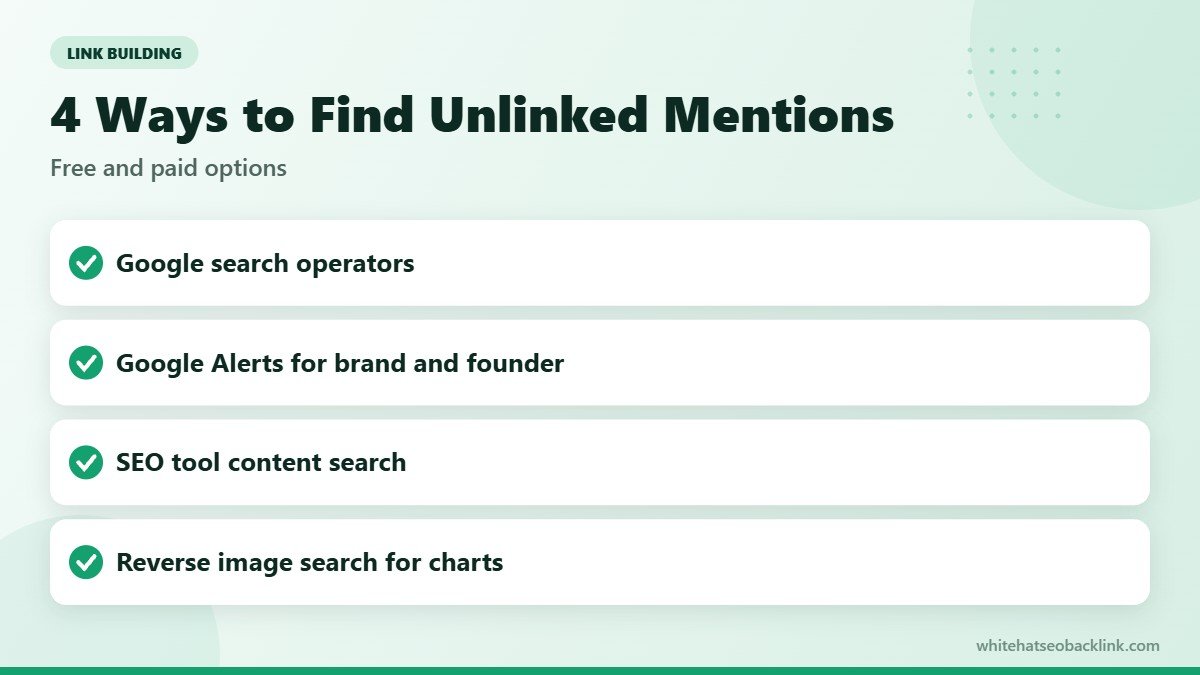
How to Find Unlinked Brand Mentions (Free and Paid Ways)
1. Use Google search operators
This is free and works well for small brands. Search for your brand name in quotes and remove your own site:
- “Your Brand” -site:yourdomain.com
- “Founder Name” “Your Brand” -site:yourdomain.com
- “Your Brand” intitle:review -site:yourdomain.com
Use the Tools menu in Google to filter to the past month or year. Fresh mentions convert much better than old ones, because the writer still remembers the article.
2. Set up Google Alerts
Create an alert for your brand name, product names and founder name. Choose “As it happens” and “Only the best results”. This turns mention hunting into a habit instead of a once a year project.
3. Use an SEO tool
Tools like Ahrefs Content Explorer let you search for your brand name across millions of pages. You can then filter for pages that do not link to your domain. This is the fastest method once you get more than a handful of mentions per month.
4. Check image and data use
Use Google reverse image search on your best charts and infographics. You will often find pages that used your image with no credit at all.
How to Decide Which Mentions Are Worth Chasing
Not every mention deserves an email. A link from a spammy page can do more harm than good. Before you reach out, check each page with this quick filter:
- Is the site real? It should have real articles, a real about page and real traffic.
- Is it relevant? A mention on a marketing blog is great for an SEO agency. A mention on a random casino site is not.
- Is the page indexed? Search the page URL in Google. If it is not indexed, the link will not help much.
- Is the mention positive or neutral? Do not ask for a link on a page that is complaining about you. Fix the problem first.
- Is the page recent? Pages from the last 12 months get the best response.
Our guest post site quality checklist works well here too, because the same quality signals apply.
Tip: Put every mention in a simple spreadsheet with columns for URL, date found, site quality, contact name, date emailed and result. This one sheet stops you from emailing the same person twice and shows you what works.
How to Find the Right Person to Contact
The best contact is the person who wrote the article, not a general info@ inbox. Look for:
- The author name and bio at the top or bottom of the article
- The author’s profile on LinkedIn or X
- An editor or content manager for larger sites
- A contact form only as a last resort
For news sites, the journalist is usually the right person. For small blogs, the owner often writes everything.
How to Ask for the Link (Email Template)
Keep the email short, friendly and specific. The writer should be able to say yes in 30 seconds. Here is a simple template you can adjust in your own words:
Subject: Thanks for mentioning [Brand] in your [topic] post
Hi [Name], I just read your article on [topic] and saw you mentioned [Brand]. Thank you, that made our day. Would you be open to linking our name to [exact URL] so readers can find us easily? It is in the paragraph that starts with “[first few words]”. Either way, thanks again for including us.
Why this works:
- You say thank you first
- You give the exact URL to link to
- You tell them exactly where the mention is, so they do not have to search
- You give them an easy way to say no

Link to the most helpful page, not always the homepage
If the article mentions your free audit tool, link to the tool page. If it mentions your pricing, link to the pricing page. The most relevant page is better for readers and usually gets approved faster.
Follow up once, then stop
If you get no reply after 5 to 7 days, send one short follow-up. If there is still no answer, move on. Repeated follow-ups hurt your reputation and rarely work.
What to Do When They Say No or Ignore You
Not every mention will become a link. That is normal. Here is what you can still do:
- Ask for a nofollow link instead. It still sends visitors and builds trust.
- Offer something useful. An updated statistic, a better image or a short expert quote can make the edit worth their time.
- Build the relationship. Share their article, comment, and stay in touch. The next time they write about your niche, they may link to you without being asked.
Never pay for a link to be added to an old mention, and never threaten or pressure a writer. That breaks Google’s spam policies and damages your brand.
Mistakes That Kill Your Results
- Using the same generic template for every site
- Asking for keyword-rich anchor text instead of your brand name (see our anchor text diversity guide)
- Chasing mentions on low quality or off-topic sites
- Sending emails months or years after the article was published
- Forgetting to check whether the page already links to you somewhere else

How Unlinked Mentions Fit Into Your Link Building Plan
Unlinked brand mentions will not be your only link source. Most growing sites get a handful each month. But they are some of the safest and highest converting links you can earn.
Use them alongside other white-hat methods like guest posting, digital PR and resource pages. Our guide to how to get backlinks covers the full list.
Many brand mentions come from press coverage, so this tactic pairs perfectly with digital PR link building. If a site removed a link you already had, follow our link reclamation guide instead.
FAQ
Are unlinked brand mentions good for SEO?
Yes. Google can see brand mentions as a sign of trust, but a real link is stronger because it passes authority and sends visitors. Turning a mention into a link gives you both.
How many unlinked mentions should I expect to convert?
It depends on your niche and how you ask. Warm, recent, well-targeted mentions convert much better than cold outreach. Track your own numbers in a spreadsheet for a few months to know your real rate.
Should I ask for a dofollow link?
Ask for a link, not for a specific link type. Most sites use a normal link by default. If they add nofollow, thank them anyway.
How often should I check for new mentions?
Once a week is ideal if you have alerts set up. A monthly check is fine for smaller brands.
Final Thoughts
Unlinked brand mentions are links you have already earned. You just have not collected them yet. Set up alerts, check quality, find the right person and send a short, friendly thank-you email.
Want to see which mentions and backlinks you are missing right now? Get a free link analysis and we will show you where your quick wins are.