How to Choose an SEO Agency: 9 Steps, 15 Questions to Ask and Red Flags to Avoid
How to Choose an SEO agency can be one of the best investments your business makes. It can also be an expensive lesson. Many business owners have a story about an agency that sent pretty reports for a year while traffic stayed flat.
The difference usually comes down to how you choose. This guide walks you through a simple 9-step process, the questions to ask on the sales call and the red flags that should make you walk away.
Before you start: do you need an agency?
An agency makes sense when you want results faster than you can manage alone, need skills you don’t have in-house (technical SEO, content, link building), or simply don’t have the time.
If your budget is very small, you might start with a freelancer or a one-off SEO audit instead. That’s fine. The steps below still help you judge anyone you hire.
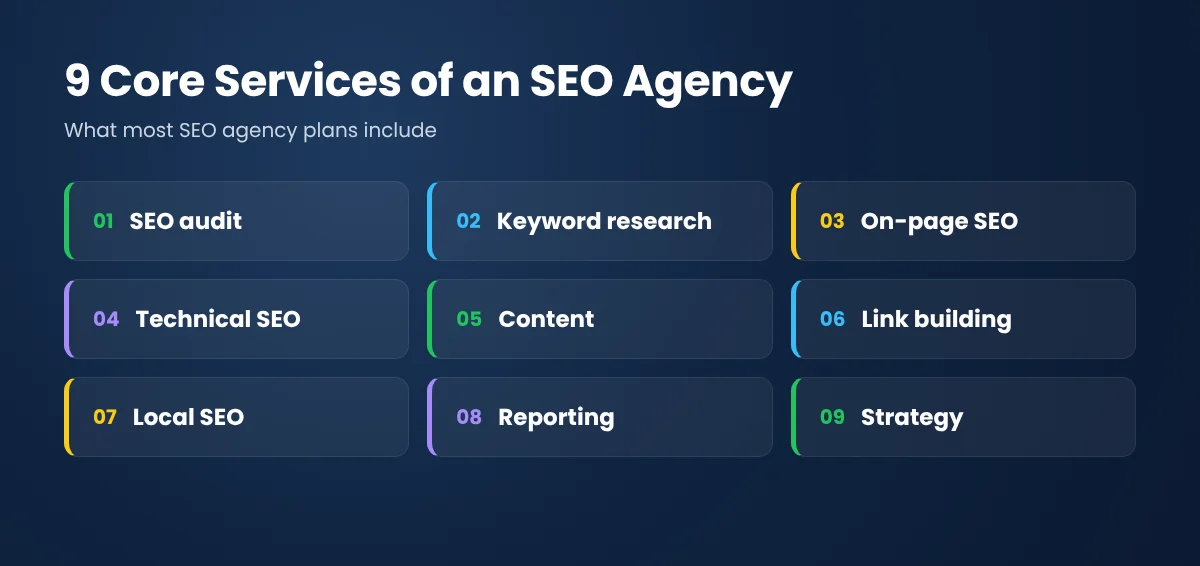
What Does an SEO Agency Do? 9 Core Services
Every agency packages things a little differently, but almost all of them cover these nine areas.
1. SEO audit
Most work starts with a full audit of your website. The agency checks how Google crawls and indexes your pages, how fast the site loads, what content you have, which keywords you already rank for and what your backlink profile looks like. The audit becomes the to-do list for the first few months.
2. Keyword research
Next, the agency figures out what your customers actually type into Google. The best keywords aren’t always the biggest ones. A smaller, specific phrase like “emergency plumber in Leeds” can bring more paying customers than a broad term like “plumbing.” Good agencies look for keywords with clear buying intent and realistic competition.
3. On-page SEO
This is about making each page clear to both people and search engines. It covers title tags, meta descriptions, headings, internal links, image alt text and the content itself. Small on-page fixes on important pages often bring some of the quickest wins.
4. Technical SEO
Technical SEO makes sure Google can find, crawl and understand your site without problems. Agencies fix things like broken pages, slow load times, duplicate content, messy redirects and indexing issues. If you want to see what that involves, our technical SEO checklist covers the main checks.
5. Content creation and optimization
Agencies plan and write content that answers your customers’ questions: service pages, blog posts, guides and FAQs. They also refresh older content that has slipped in rankings. Good content gives Google a reason to rank you, and it gives visitors a reason to stay.
6. Link building
Links from other trusted websites are still one of Google’s strongest ranking signals. A good agency earns links through outreach, guest posts, digital PR and partnerships, while avoiding the spammy shortcuts that can get a site penalized. This is often the hardest part of SEO to do in-house. You can learn more about the off-page SEO process here.
7. Local SEO
If you serve customers in a specific area, the agency will optimize your Google Business Profile, build local citations, manage reviews and target “near me” and city-based searches. For many service businesses, local SEO is where most new leads come from.
8. Reporting and analytics
You should get clear reports showing rankings, organic traffic, leads and what was done that month. A good agency explains the numbers in plain language and tells you what’s planned next. If you can’t understand your report, that’s a problem with the report, not with you.
9. Strategy and ongoing advice
Behind all the tasks is a strategy: which pages to prioritize, which competitors to target, and how SEO fits with your other marketing. The best agencies act like a partner who knows your business, not a vendor ticking boxes.
Not sure whether you need an agency, a freelancer or an in-house hire? Read our full comparison of SEO agency vs freelancer before you build your shortlist.
Step 1: Define your goals in plain numbers
“We want to rank higher” isn’t a goal. Before you contact anyone, write down:
- What you want more of: leads, sales, calls or bookings.
- Which products, services or locations matter most.
- Where you are now: traffic, leads and main keywords (if you know them).
- Your budget range and how long you can commit.
Clear goals make it easy to compare agencies, and they stop an agency from choosing easy keywords that look good in reports but don’t bring customers.
Step 2: Decide what kind of help you need
Not every agency does everything well. Match the agency to your situation:
| Your situation | Look for an agency strong in |
|---|---|
| Local business (plumber, dentist, lawyer) | Local SEO, Google Business Profile, reviews, local links |
| Online store | Technical SEO, category pages, product content |
| New website with little authority | Content strategy and link building |
| Large site with traffic drops | Technical audits, migrations, recovery |
| Service business in a competitive niche | Content plus quality backlinks |
Step 3: Build a shortlist of 3 to 5 agencies
Good places to look:
- Recommendations from business owners you trust.
- Agencies whose content you already find useful.
- Industry communities and LinkedIn.
- Review platforms, with a healthy dose of caution.
Bonus test: search for your industry plus “SEO agency” and see who ranks. An agency that can’t rank itself has some explaining to do, although some great agencies get all their work from referrals.
Step 4: Check real results, not promises
Ask each agency for case studies similar to your business. A good case study shows:
- The starting point and the timeline.
- What the agency actually did.
- Business results like leads or revenue, not only rankings.
- A client you can contact, where possible.
Screenshots of traffic graphs are easy to cherry-pick. Ask what happened in the months after the graph ends.

Step 5: Understand exactly how they’ll get results
Ask them to walk you through their process for your site. You should hear about:
- An audit of your site, competitors and keywords.
- A plan with priorities, not a generic checklist.
- Technical fixes, content work and link building.
- How they’ll report progress and how often.
Pay close attention to link building. Ask where links come from and how sites are chosen. Vague answers like “our network” or “high DA links” are a warning sign. A good agency can explain how it checks site quality, like the points in our guest post site quality checklist.
Step 6: Ask these 15 questions on the sales call
Use these questions to compare agencies side by side:
- What would you focus on first for my site, and why?
- Which keywords do you think we can realistically win in 6 months?
- Can you share 2 or 3 case studies from businesses like mine?
- Who will actually work on my account, and what’s their experience?
- How do you build links, and can I see examples?
- What technical issues did you notice on my site already?
- How will you measure success beyond rankings?
- What will you need from me and my team?
- How often will we talk, and what will reports include?
- Do I own the content, accounts and data if we stop working together?
- What’s included in the price, and what costs extra?
- Is there a minimum contract length? What’s the notice period?
- What happens if we don’t see progress after 6 months?
- How do you keep up with Google algorithm updates?
- Have you ever had a client hit by a penalty? What did you do?
Good agencies welcome these questions. If an agency gets defensive or answers everything with jargon, take note.
Step 7: Compare pricing the right way
SEO pricing varies a lot by country, niche and scope. Common models include monthly retainers, fixed-price projects (like audits) and hourly consulting.
Don’t compare price alone. Compare what you get: hours, number of content pieces, number and quality of links, technical work and reporting. A cheap package that builds spammy links can end up costing much more when you have to clean it up.
Step 8: Watch for these red flags
- Guaranteed #1 rankings. Nobody controls Google. Google’s own guide to hiring an SEO warns about this.
- Secret methods they won’t explain.
- Hundreds of links for a low monthly fee.
- They want to own your accounts (Google Analytics, Search Console, your domain).
- Long contracts with no exit clause.
- Reports full of vanity metrics and nothing about leads or sales.
- No questions about your business. A good agency wants to understand your customers.
Step 9: Start small and set a 90-day check-in
If you can, start with an audit or a short initial period. Agree on what should be done and what early signs of progress look like by day 90. SEO takes time, but by then you should see completed work, a clear plan and early movement in impressions or rankings for target pages.

What a good SEO agency relationship looks like
Once you’ve picked one, the best results come from working together. Give them access, answer questions quickly, share sales insights and approve content without long delays. In return, expect honest updates, including when something isn’t working.
If you run an agency yourself and want to win more of these clients, our guide on how to get SEO clients covers the other side of the table.
What to Expect From an SEO Agency, Month by Month
Once you sign, a good agency follows a clear rhythm. Here is what the first year usually looks like, so you can tell whether your agency is on track.
Before Work Starts: Onboarding
A professional agency will start with an onboarding process, not straight into “doing SEO”. In the first week or two, expect:
- A kickoff call to learn about your business, customers, best-selling services and goals.
- Access requests for Google Search Console, Google Analytics, your website and, for local businesses, your Google Business Profile.
- Agreed goals and KPIs, ideally tied to leads or sales, not just rankings.
- A named contact and a set schedule for reports and calls.
If an agency never asks about your customers or profit margins, that’s a sign they plan to run a generic checklist rather than a strategy for your business.
Month 1: Audit, Research and Strategy
Month one is where many clients first wonder what to expect from an SEO agency. The first month is mostly about understanding where you stand. You may not see visible changes yet, and that’s normal. Expect these deliverables:
- Technical SEO audit: crawl errors, indexing problems, site speed, mobile issues and broken links.
- Keyword research: the searches your customers actually use, grouped by intent and priority.
- Competitor analysis: who ranks above you, and why.
- Backlink audit: the quality of links already pointing to your site.
- A written strategy: what they’ll do, in what order, and why.
Ask for the audit and strategy in writing. You paid for them, and they’re useful even if you change agencies later.

Months 2–3: Fixes and Foundations
Now the real work begins. A good agency will usually tackle quick wins first:
- Fixing technical problems found in the audit
- Rewriting page titles and meta descriptions for better click-through
- Improving existing pages that are close to page one
- Strengthening internal linking
- Setting up conversion tracking so you can see leads, not just visits
By the end of month three, you’ll often see early movement: more keywords ranking, impressions rising in Search Console and a few pages climbing toward the first page.
Months 4–6: Content and Authority
With the foundations fixed, the focus shifts to growth. This usually means:
- New content aimed at keywords your customers search before buying.
- Link building to grow your site’s authority with relevant, trusted backlinks.
- Local SEO work such as reviews and citations, if you serve a local area.
This is the stage where traffic and enquiries normally begin to grow in a meaningful way. Link building is often the biggest cost here. Our guide on how much link building costs explains what’s reasonable to pay.
Months 6–12: Growth and Refinement
After six months, a good agency should be using real data to double down on what works. Expect more content around your best-performing topics, conversion improvements on high-traffic pages, and a refreshed strategy based on results so far.

What Your Monthly SEO Report Should Show
What to expect from an SEO agency? A report full of jargon and screenshots isn’t a good report. You should be able to understand it in five minutes. A useful monthly report includes:
| Section | What it tells you |
|---|---|
| Work completed | Exactly what was done this month and why |
| Organic traffic | Visits from Google compared with last month and last year |
| Leads and sales | Calls, forms and orders that came from organic search |
| Keyword rankings | Movement for your priority keywords, not hundreds of irrelevant ones |
| Links built | A list of new backlinks with the URLs, so you can check them |
| Next steps | The plan for next month |
Final thoughts
Knowing how to choose an SEO agency comes down to a few things: clear goals, a short list of specialists, proof of real results, a transparent process and honest pricing. Ask the 15 questions, watch for red flags and start with a clear 90-day plan.
Looking for a white-hat partner for link building? Learn more about our services, or start with a free link analysis so you can judge our work before you commit.
Frequently asked questions
How long should I give an SEO agency to show results?
Expect early progress such as completed fixes and rising impressions within 3 months, and clearer traffic and lead growth within 6 to 12 months. It depends on competition and your site’s starting point.
Should I choose a local SEO agency or a remote one?
Either can work. What matters is experience with businesses like yours. A local agency can help if you want in-person meetings or local market knowledge.
Is it better to hire an SEO agency or a freelancer?
Freelancers are often cheaper and great for focused tasks. Agencies offer a wider team (technical, content, links) and more capacity. Pick based on the scope of work you need.
What should an SEO report include?
Work completed, rankings for target keywords, organic traffic, conversions or leads from organic search, links built, and next steps. If you can’t tie the report to business results, ask for changes.