
How to Price SEO Services: A Simple Formula for Agencies and Freelancers
Pricing is the question every new SEO agency and freelancer struggles with. Charge too little and you burn out doing great work for no profit. Charge too much without a clear reason and prospects disappear.
Most guides answer the question with a list of average rates. That is useful, but it does not tell you what you should charge. This guide shows how to price SEO services using a simple formula based on your real costs and time, then how to turn that number into packages clients understand.
Why It Is Hard to Price SEO Services
SEO is not a product with a fixed cost. One client needs a quick technical fix; another needs a year of content and links. Results also take months, so clients are paying for work they cannot see right away.
That is why the way you price SEO services needs to do two jobs: cover your costs with a healthy margin, and make the value easy for a client to understand.
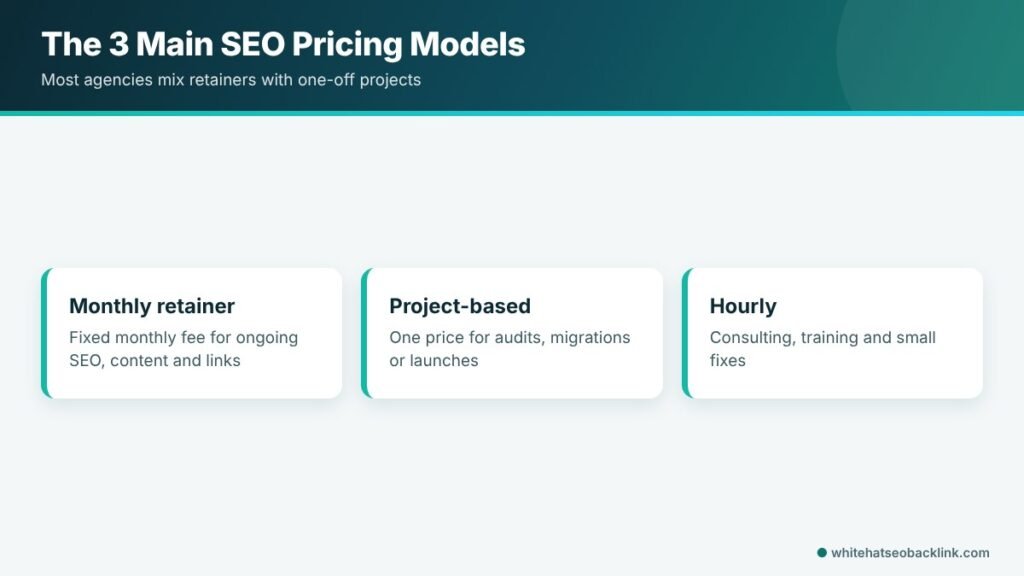
The 3 Main SEO Pricing Models
| Model | How it works | Best for |
|---|---|---|
| Monthly retainer | Fixed fee each month for ongoing work | Long-term SEO, content and links |
| Project-based | One price for a defined job | Audits, migrations, site launches |
| Hourly | Paid for time used | Consulting, training, small fixes |
Most agencies use retainers for ongoing work and projects for one-off jobs. Hourly works well for consulting, but it rewards being slow, so many experienced consultants move away from it.
How to Price SEO Services: The Cost-Plus Formula
Here is a simple way to price SEO services for any client. It starts with your costs, not with guesses.
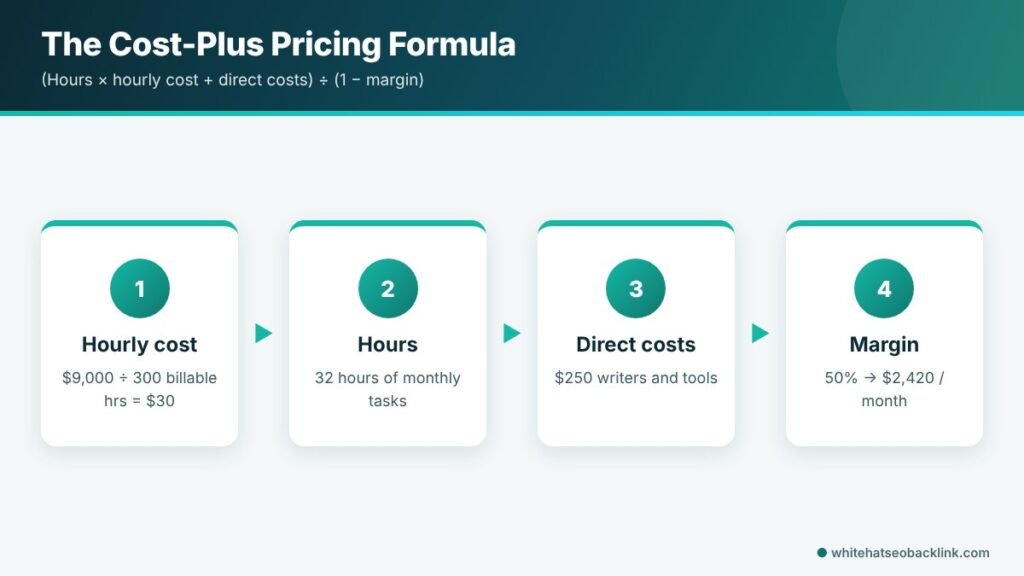
Step 1: Work out your real hourly cost
Add up your monthly costs: salaries (or what you want to pay yourself), tools, software, office, and admin. Divide by the number of billable hours you actually work, not total hours.
For example, a small team with $9,000 in monthly costs and 300 billable hours has a real cost of $30 per hour.
Step 2: Estimate the hours for the scope
List the monthly tasks for the client and estimate the time each one takes:
| Task | Hours per month |
|---|---|
| Keyword tracking and reporting | 3 |
| Technical checks and fixes | 4 |
| Two blog posts (research, writing, editing) | 10 |
| On-page optimisation | 4 |
| Link building outreach | 8 |
| Calls and account management | 3 |
| Total | 32 |
Step 3: Add direct costs
Include anything you pay for per client: writers, link placements, extra tools or design work. Say this client needs $250 in direct costs.
Step 4: Add your margin
Most healthy agencies aim for a gross margin of 40% to 60%. Use this formula:
Price = (Hours × hourly cost + direct costs) ÷ (1 − margin)
With our example: (32 × $30 + $250) ÷ (1 − 0.5) = $1,210 ÷ 0.5 = $2,420 per month.
You might round that to $2,450 and present it as your “Growth” package. That is the core of how to price SEO services without guessing.
Adjust for Value and Competition
The formula gives you a floor, not a ceiling. Adjust it using these factors:
- Competition: Ranking a personal injury lawyer in a big city takes far more work than a bakery in a small town.
- Client value: If one new client is worth $20,000 to a law firm, a higher fee is easy to justify.
- Your experience: Proven case studies let you charge more.
- Location of the client: Clients in the US, UK and Australia usually expect higher rates than local markets with lower costs.
- Urgency: Rush projects should cost more.
This is where value-based pricing comes in. Once you understand what a lead or sale is worth to a client, you can price SEO services as an investment with a clear return, not as a cost.
Turn Your Price Into 3 Packages
People like choice, but not too much. Three tiers work well because most buyers pick the middle one.
| Package | Who it suits | What it includes |
|---|---|---|
| Starter | Small local businesses | Local SEO, technical fixes, 1 post, monthly report |
| Growth | Growing businesses | Everything in Starter, 2–4 posts, outreach links |
| Authority | Competitive industries | Full strategy, 6+ posts, digital PR, priority support |
Price each tier with the cost-plus formula, then check that the jump between tiers feels fair. Put the details in a clear SEO proposal so clients see exactly what they get.
Common Price Ranges in 2026
Rates vary widely by country and experience, but these ranges are common for agencies serving small and mid-sized businesses in Western markets:
| Service | Typical range |
|---|---|
| Local SEO retainer | $500 – $2,000 per month |
| Small business SEO retainer | $1,000 – $3,000 per month |
| Competitive or ecommerce SEO | $3,000 – $10,000+ per month |
| One-off SEO audit | $500 – $5,000 |
| SEO consulting | $75 – $200 per hour |
Use these as a reality check, not as your price. If your formula lands far below the range, you may be underpricing. If it lands far above, check your hours or your scope. For link costs specifically, see how much link building costs.

How to Price SEO Services by Client Type
Different businesses need different work, so a single rate card rarely fits everyone.
Local businesses such as dentists, plumbers and salons usually need Google Business Profile work, reviews, citations and a few strong service pages. The scope is smaller, so you can price SEO services for them at the lower end and still earn a good margin, especially if you build repeatable processes.
Ecommerce stores have hundreds or thousands of pages. Technical SEO, category page content and product schema take far more time. Price SEO services for online stores based on the number of pages and templates, not a flat fee.
SaaS and B2B companies often need in-depth content and digital PR to compete with well-funded rivals. Their customer value is high, so value-based pricing makes sense. When you price SEO services for these clients, tie your fee to qualified leads or demo requests, not traffic alone.
How to Present Your Price
Once you price SEO services, how you present the number matters as much as the number itself.
- Start with goals. Show the traffic, leads or sales you are aiming for before you show the fee.
- Show the work. List deliverables so the price feels earned.
- Set a minimum term. Three to six months is normal, because SEO takes time.
- Explain reporting. Clients relax when they know what they will see each month. A clear monthly SEO report helps.
- Never promise rankings. Promise work, transparency and effort.
When and How to Raise Your Prices
Many freelancers price SEO services once and keep the same rate for years. Review your rates every six to twelve months. Raise them when your calendar is full, your results improve, or your costs rise. Give existing clients 30 to 60 days’ notice and remind them of the results you have delivered. New clients simply get the new rates.
SEO Retainers: What to Include and How to Structure One
Most agencies sell SEO as a monthly retainer. If you price your services this way, here is what a retainer usually covers and how to set one up so clients stay.
What is an SEO retainer?
An SEO retainer is an ongoing agreement where a client pays a fixed monthly fee for a set amount of SEO work. Instead of paying for each task, the client “retains” the agency or consultant to look after their search performance over time.
It is different from:
- Project-based SEO, such as a one-time audit or site migration
- Hourly consulting, where you pay only for time used
- Performance-based SEO, where fees depend on results like rankings or leads

What does an SEO retainer usually include?
Every agency packages it differently, but most monthly plans include a mix of the following:
Technical SEO
Regular health checks, fixing crawl and index issues, site speed improvements and monitoring Search Console. For example, fixing problems like Discovered – currently not indexed pages.
On-page optimisation
Improving titles, meta descriptions, headings, internal links and content on key pages.
Content
Planning, writing or updating blog posts and service pages based on keyword research.
Link building
Earning quality backlinks through outreach, digital PR and partnerships.
Local SEO
Managing Google Business Profile, local citations and reviews for local businesses.
Reporting and strategy
A monthly report, a call to discuss progress and a plan for the next month. See our guide to the SEO report for clients for what a good report includes.
What to look for in an SEO retainer contract
A clear contract protects both sides. Check that it covers:
- Scope of work: exact tasks or hours per month
- Minimum term: often 3 to 6 months, then month-to-month
- Notice period: usually 30 days to cancel
- Ownership: the client should own all content, accounts and data
- Reporting: what is reported, how often and in what format
- Access: which logins the agency needs and how they are handled
- No guarantees of #1 rankings: honest agencies never promise this

SEO retainer vs. one-off project: which is better?
A one-off project makes sense for a clear, limited task like a site migration or a technical audit. An SEO retainer makes more sense when you want ongoing growth from content, links and steady improvements.
Many businesses start with a project and move to a retainer once they trust the agency. This is often the best path for both sides.
How to keep retainer clients longer
Winning the client is step one. Keeping them is where profit lives. What competitors rarely mention is that most clients leave because of poor communication, not poor results.
To keep clients for years:
- Report on business results, like leads and sales, not only rankings
- Show what was done every month in simple language
- Share quick wins early, even small ones
- Hold a quarterly strategy review to reset goals
- Be honest when something is not working and explain the fix
Our post on what to expect from an SEO agency gives a month-by-month timeline you can share with clients.
Pricing Mistakes to Avoid
These mistakes are common when people price SEO services for the first time:
- Copying a competitor’s price without knowing their costs
- Pricing by the hour for long-term retainers
- Offering “unlimited” anything
- Discounting heavily to win a client who then expects more
- Forgetting tool costs and account management time
- Not charging for onboarding work. Our client onboarding checklist shows how much time it really takes

Pricing When You Use White Label Partners
If you resell work from a white label SEO provider, add their fee as a direct cost in Step 3, then add your management time and margin. A markup of 50% to 100% is common because you handle sales, strategy and the client relationship.
Final Thoughts
You do not need to guess. Work out your real hourly cost, estimate the hours, add direct costs and a healthy margin, then shape the number into clear packages. When you price SEO services this way, you protect your profit and give clients a price they can understand and trust.
FAQs
What is a fair monthly price for SEO?
For a small local business, $500 to $2,000 a month is common. Competitive industries often need much more.
Should I charge a setup fee?
Yes, if the first month includes audits, tracking setup and technical fixes. Many agencies charge a one-time onboarding fee.
How do freelancers price SEO services differently from agencies?
Freelancers have lower costs, so they can charge less and still earn well. They should still use the same formula so they do not underprice their time.
Is performance-based SEO pricing a good idea?
It can work for experienced teams, but rankings depend on things you do not control. Most agencies use a base fee plus a bonus instead.
How often should I review my prices?
Every six to twelve months, or whenever your costs or results change significantly.