How Much Does Link Building Cost in 2026? Real Prices and Pricing Models
Ask five providers for a quote and you’ll get five numbers that make no sense together: $40 a link, $350 a link, $2,500 a month, “it depends.” This guide explains what link building cost really looks like in 2026, what drives the price, and how to set a budget that buys rankings instead of risk.
The Short Answer
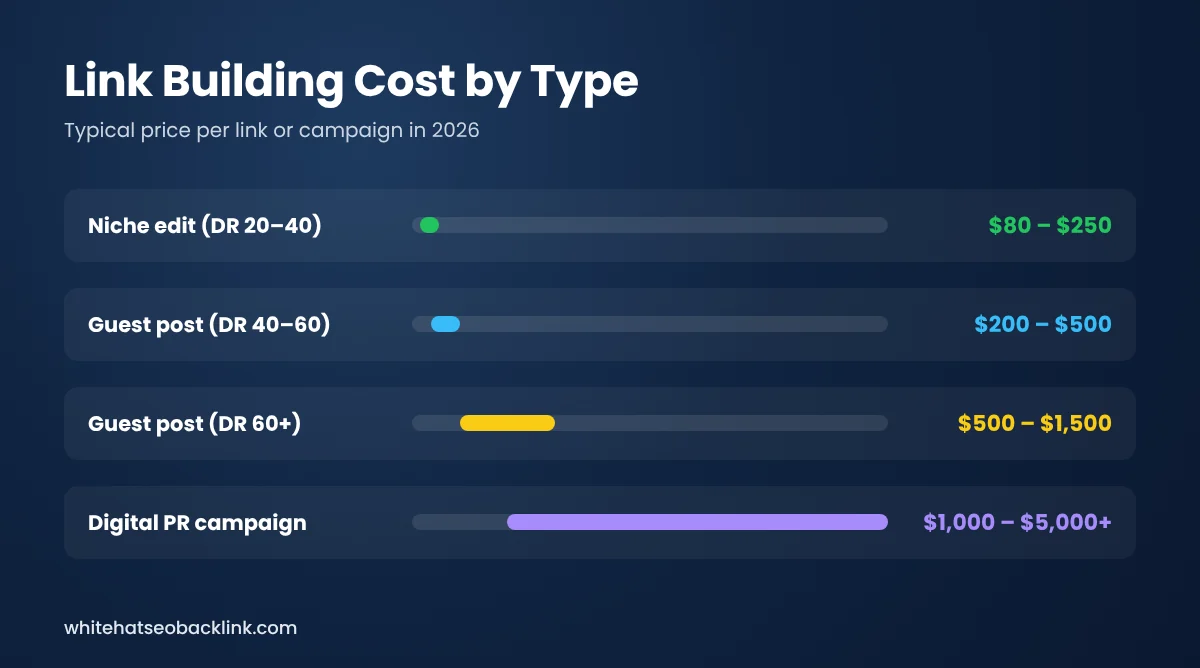
For a real editorial link on a relevant website with actual organic traffic, the typical link building cost is $150 to $600 per link. Links from major publications can cost $1,000 or more. Agency retainers usually run from about $1,000 to $10,000+ per month, depending on volume and how competitive your niche is.
| Link type | Typical cost per link | Best for |
|---|---|---|
| Niche edit on a relevant blog (DR 20–40) | $80 – $250 | New and local sites |
| Guest post on a mid-authority site (DR 40–60) | $200 – $500 | Most small businesses |
| Guest post on a strong site (DR 60+) | $500 – $1,500 | Competitive niches |
| Digital PR link | $1,000 – $5,000+ per campaign | Brands that need big trust signals |
BuzzStream’s 2026 research puts the average guest post at about $295 when you buy direct from the publisher and $461 through a vendor, link insertions at about $179, and digital PR at $1,250 to $1,500 per unique link (source).
These are typical agency and vendor prices. Some providers who work directly with publishers, without a reseller layer, can offer real DR 40+ placements for less, from around $80 per post. The difference is in the business model, not the quality, and you can confirm it by asking for sample live posts and checking each site’s organic traffic yourself.
If you see “100 backlinks for $20,” that isn’t a cheaper version of the same product. It’s a different product, and usually one that can hurt you.
What Drives Link Building Cost?
Two providers can both say “guest post” and mean completely different things. These six factors decide the real link building cost.
1. Authority and traffic of the linking site
A site with real organic traffic, a clean backlink profile and an editor who reviews content costs more. Domain Rating (Ahrefs) and Domain Authority (Moz) are useful starting points, but both can be inflated. Organic traffic is the better signal. If a DR 70 site gets 200 visits a month, it isn’t a DR 70 site in any way that matters.
2. Topical relevance
A link from a site in your industry is worth more than one from a stronger site in an unrelated niche. Relevant sites are fewer and their editors are pickier, so they cost more. That premium is worth paying, because relevance is what helps Google and AI search tools connect your brand with your topic.
3. Content and outreach work
Every real link involves people: someone finds the site, pitches the editor, writes a useful article, handles edits and follows up. When a price looks impossibly low, this is the work that’s been skipped.
4. Your industry
Finance, legal, health, SaaS and gambling sit at the top of the link building cost range. These are YMYL or highly competitive niches where publishers know links are valuable. A local bakery or hobby blog can rank with far less spend.
5. Placement and attributes
A link inside the main body of an article, with natural anchor text, is worth more than one in a footer, author bio or sidebar. Dofollow links usually cost more than nofollow or rel=”sponsored” links, though a natural profile has both.
6. Vendor markup
Many sellers resell the same publisher inventory with a margin on top. Buying through a vendor saves you time but can add 50% or more to each link. That’s fine when the vendor adds vetting, content and reporting, and a waste when they only forward an order.
Link Building Cost by Pricing Model
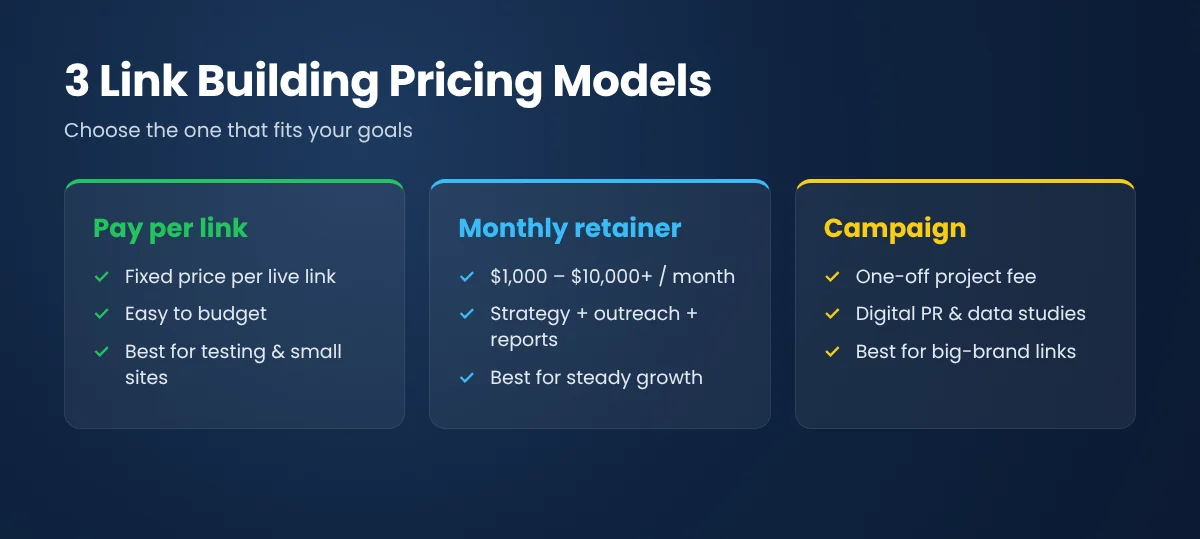
Your link building cost also depends on how a provider charges. Most use one of four models.
Pay per link
You pay a fixed price for each live link. It’s easy to budget and good for testing a provider or filling specific gaps. Watch out for sellers who show only a DR number and nothing about traffic or relevance.
Monthly packages
A fixed number of links each month at a set price. Monthly link building packages give you predictable output and a steady link velocity, which looks natural to Google.
Retainer
You pay $1,000 to $10,000+ a month and the agency handles strategy, outreach and reporting. Best for competitive markets where you need ongoing growth. Avoid retainers with no clear deliverables.
Campaign pricing
A one-off fee for a digital PR campaign, data study or linkable asset. Prices usually start around $3,000 and can pass $15,000. Ask for a minimum placement commitment.
How to Set Your Link Building Budget
There’s no single right number, but this three-step method keeps you close.
- Measure the gap. In Ahrefs or Semrush, check how many referring domains the top three pages have for your main keyword. If they have 60 and you have 10, you know the size of the gap.
- Choose a safe pace. Five to ten quality links a month is realistic for most small and mid-sized sites.
- Multiply by a fair price. Ten links at $250 each is $2,500 a month. Five links at $200 is $1,000.
As a rough guide to monthly link building cost:
- Local business or new site: $500 – $1,500
- Growing small business or ecommerce store: $1,500 – $4,000
- Competitive national niche or SaaS: $4,000 – $10,000+
Cheap Links vs Quality Links
A $30 link and a $300 link look the same on an invoice. They are not.
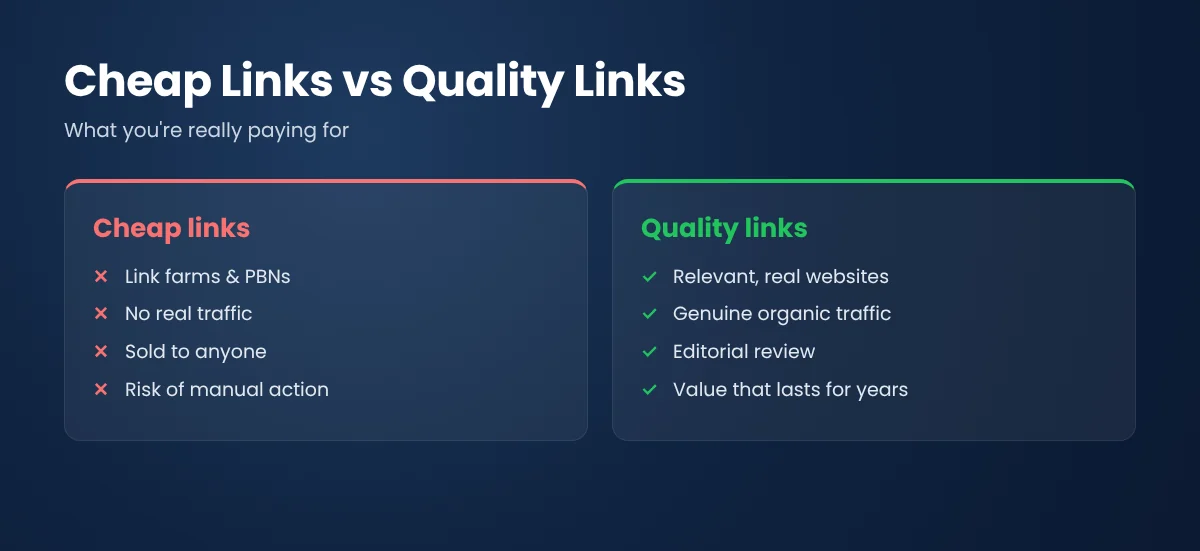
Cheap links usually come from private blog networks (PBNs), guest post farms or sites that sell to anyone. Google’s spam policies name link schemes directly, and its systems usually ignore these links. In worse cases they lead to a manual action, and cleanup through Google Search Console and a disavow file costs far more than you saved.
The true link building cost includes the risk each link brings. One relevant editorial link can do more for your rankings than fifty low-quality ones.
Red Flags in a Link Building Quote
- Guaranteed rankings. No honest provider can promise a #1 spot.
- Huge link counts at tiny prices. “500 backlinks for $30” means automated, worthless links.
- No sample sites. A good provider shows the kind of sites they use.
- DR is the only metric. Ask for organic traffic, niche and country.
- No replacement policy. Links sometimes disappear, and a fair provider replaces them.
- Vague reporting. You should get every live URL, anchor and publish date.
How to Get More From Every Dollar
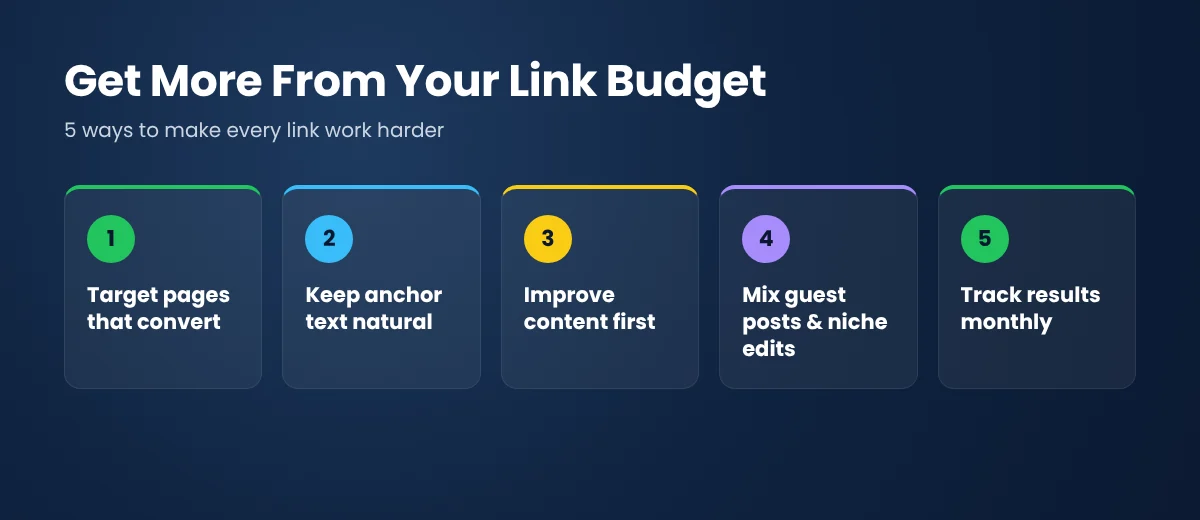
- Link to pages that convert. Service pages, product pages and your best guides give the best return.
- Keep anchors natural. Mix branded, partial-match and URL anchors. See our anchor text diversity guide.
- Fix your content first. Links work best when the page is already the best answer.
- Mix link types. Compare niche edits vs guest posts before you order.
- Measure results. Track referring domains, rankings and organic traffic for each target page.
Is Link Building Worth the Cost?
For most businesses that rely on Google traffic, yes. Backlinks remain one of the strongest ranking signals, and links from trusted sites also help your brand appear in AI Overviews and answers from ChatGPT and Perplexity. Treat link building cost as an investment you measure. If rankings and traffic for your target pages trend up over three to six months, your budget is working.
Frequently Asked Questions
How much does a single backlink cost?
The link building cost for one good editorial backlink is usually $150 to $600. Links from very authoritative sites or major media can cost $1,000 or more.
What is the average link building cost per month?
Most small and mid-sized businesses spend $1,000 to $5,000 per month. Competitive SaaS, finance and legal sites often spend $5,000 to $15,000.
Why are some backlinks so cheap?
Very cheap links usually come from link farms, PBNs or sites that sell to anyone. They skip the outreach and content work that makes a link valuable.
How many links should I build per month?
For most sites, 5 to 10 quality links a month is a safe pace. Steady growth looks more natural than sudden spikes.
How long until link building shows results?
Most sites see ranking movement within 2 to 4 months, with stronger results after 6 months.
Final Thoughts
For real, relevant links, plan on $150 to $600 per link or $1,000 to $5,000 a month for most businesses. Prices far below that are only worth it when the provider shows real sites, real traffic and live samples. When they can’t, it usually means the hard work is being skipped.
Want to know your exact link building cost before you spend anything? Request a free link analysis and we’ll show the gap between you and your competitors, or compare our link building packages starting with a $50 trial post.