AI SEO Strategy: A 7-Step Plan to Rank in Google and AI Answers (2026)
Search no longer ends on a page of ten blue links. A buyer might read a Google AI Overview, ask ChatGPT a follow-up, then check Perplexity before they ever click a result. If your brand isn’t part of those answers, you lose the visit before it starts.
The good news: you don’t need a brand-new playbook. A solid AI SEO strategy is classic SEO done with more discipline, plus a few habits that help large language models understand, trust and quote you. This guide walks through the seven steps we use, in order, with the mistakes to avoid.
What is an AI SEO strategy?
An AI SEO strategy is a plan for earning visibility in two places at once: traditional Google rankings and the answers generated by AI tools such as Google AI Overviews, AI Mode, ChatGPT search, Gemini, Copilot and Perplexity. It covers how you structure content, how clearly you define your brand as an entity, and how often other trusted sites mention you.
Some people call this generative engine optimization (GEO) or answer engine optimization (AEO). The labels change; the goal stays the same. You want machines to pick your page as the most reliable answer, and you want humans to choose you once they see it. If you’re new to the topic, our guide to LLM SEO explains how language models choose sources.
Why your old SEO plan isn’t enough on its own
Rankings still matter. Most AI systems retrieve pages from a search index before writing an answer, so pages that rank well get considered more often. But three things are different:
- Fewer clicks per search. When an AI Overview answers the question, fewer people scroll down. Being cited inside the answer is now part of winning the SERP.
- Query fan-out. Google AI Mode and ChatGPT break one question into many sub-questions. A page that covers the full topic gets pulled into more of those sub-searches.
- Brand mentions carry weight. Language models learn which brands belong with which topics from the wider web, including forums, reviews and news. Links are still important, but unlinked mentions count for more than they used to.
A modern AI SEO strategy treats these as features of the landscape, not threats.

The 7-step AI SEO strategy
Here is the full AI SEO strategy framework. Work through it in order, because each step makes the next one easier.
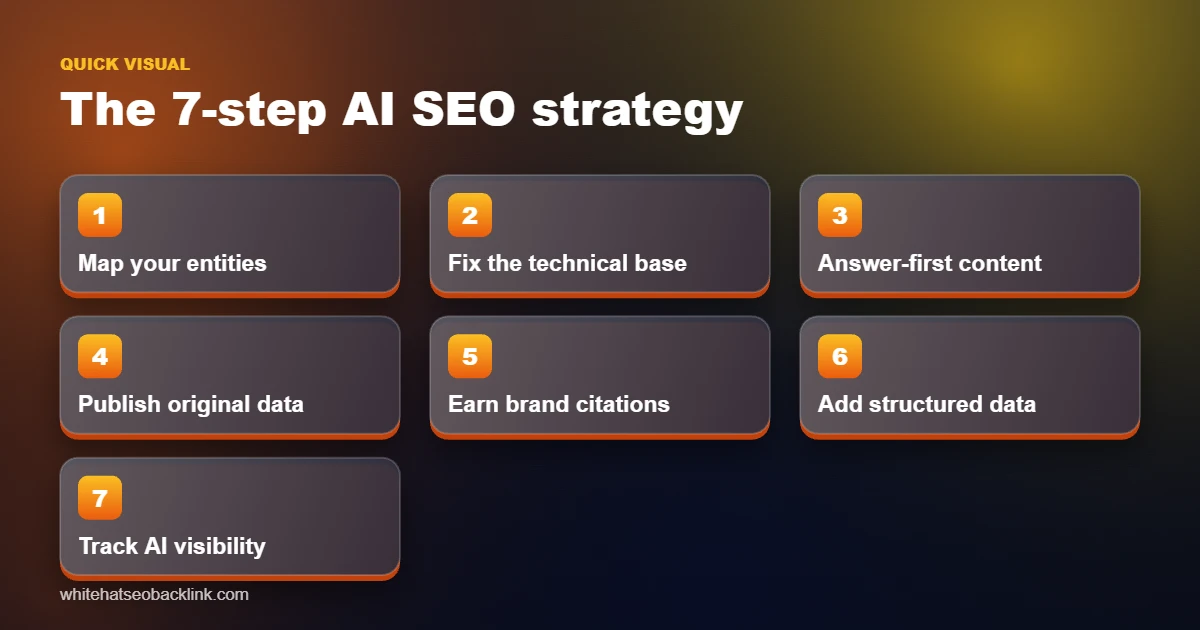
Step 1: Map your entities and topics
An entity is a thing Google can identify without ambiguity: your company, your founder, your product, the city you serve, the problems you solve. Google’s Knowledge Graph and the training data behind AI models are built around entities, not keywords.
Every AI SEO strategy should start with this map. Write down:
- Your brand name and the exact category you want to be known for (for example, “white hat link building agency”).
- The five to ten core topics you want to own.
- The people behind the brand and their real credentials.
- Related entities that should appear next to you: tools, standards, locations, industries.
Use that map to plan topic clusters so every core topic has a pillar page and supporting articles. Consistent naming across your site, Google Business Profile, LinkedIn and directory listings helps machines connect the dots.
Step 2: Fix the technical base
No AI SEO strategy survives a site that crawlers can’t read. AI answer engines depend on clean, fast, indexable HTML, and many AI crawlers don’t render JavaScript at all.
- Check that important pages are indexed in Google Search Console and Bing Webmaster Tools. Bing matters because ChatGPT search relies heavily on its index.
- Make sure your main content is in the HTML source, not loaded only by JavaScript.
- Review robots.txt so you aren’t accidentally blocking crawlers such as OAI-SearchBot, PerplexityBot or Google-Extended unless you mean to.
- Keep pages fast and mobile friendly.
Our technical SEO checklist covers each item in detail.
Step 3: Write answer-first content
AI systems lift short, self-contained passages. If your answer is buried in paragraph nine, it won’t get quoted. Structure every key page like this:
- A question-style heading that matches how people search.
- A direct two to three sentence answer right below it.
- Supporting detail, examples and steps after that.
Write as if each section might be read alone, because it often will be. Define terms the first time you use them, name the entities involved, and avoid vague pronouns like “this” at the start of a section. That clarity is the heart of a practical AI SEO strategy.
Step 4: Publish something only you can say
Models are trained on huge amounts of repeated advice. They have no reason to cite you for a tenth version of the same tips. They do cite original data, first-hand tests, clear frameworks and expert opinions.
Ideas that work well:
- A small survey of your customers or industry, published with the method.
- Before-and-after results from real projects, with numbers.
- Templates, checklists and calculators people reference later.
- Quotes from practitioners with names and job titles.
Original material is the part of an AI SEO strategy competitors can’t copy. It is also how you show E-E-A-T (experience, expertise, authoritativeness and trustworthiness), which Google’s quality raters look for.
Step 5: Earn brand citations across the web
When a language model decides which brands to recommend, it leans on what the wider web says. That means your AI SEO strategy needs an off-site plan:
- Digital PR. Newsworthy data and expert commentary earn mentions on news and trade sites. See our guide to digital PR link building.
- Relevant guest posts on real sites in your niche that place your brand next to your core topics.
- Community presence. Helpful answers on Reddit, Quora and industry forums show up in AI answers surprisingly often.
- Reviews and listicles. “Best X for Y” articles are a favourite source for AI tools. Ask to be included where you genuinely qualify.
- Unlinked mentions. Turn them into links with a simple reclamation process.
Step 6: Add structured data
Schema.org markup won’t make a weak page rank, but it removes doubt. Use Organization schema with sameAs links to your social profiles, Person schema for authors, and Article, FAQPage, HowTo or Product schema where they truly fit. Keep markup accurate; it should match what users see on the page.
Schema is a small but useful layer in any AI SEO strategy. Some sites also add an llms.txt file to point AI tools to their best content. Support is still limited, so treat it as optional. You can read more in our llms.txt explainer.
Step 7: Track AI visibility, not just rankings
What you measure shapes what you improve. Alongside rankings and organic traffic, track:
- AI citations. Run your top 20 to 50 prompts in ChatGPT, Perplexity, Gemini and Google AI Mode each month and record whether you’re mentioned or linked.
- AI referral traffic. In GA4, create a segment for referrers like chatgpt.com, perplexity.ai and gemini.google.com.
- Branded search growth. When AI tools mention you, people often search your name next. Watch branded impressions in Search Console.
- Share of voice against two or three main competitors.
Review these numbers quarterly and update your AI SEO strategy based on which pages and topics get cited most.
AI SEO strategy vs traditional SEO
| Area | Traditional SEO | AI SEO |
|---|---|---|
| Main goal | Rank a page in the top 10 | Be cited or recommended in the answer |
| Unit of content | The whole page | Self-contained passages and facts |
| Authority signal | Backlinks | Backlinks plus brand mentions and entity clarity |
| Key metric | Rankings and clicks | Citations, mentions and assisted conversions |
The two overlap far more than they differ. Strong rankings feed AI visibility, and the clarity AI tools reward also helps traditional results.
Common mistakes to avoid
- Mass-producing AI content. Using AI to help write is fine. Publishing hundreds of thin, unedited pages is not, and Google’s spam policies on scaled content abuse target exactly that.
- Ignoring Bing. If Bing can’t index you, ChatGPT search likely can’t find you either.
- Chasing prompts instead of topics. Prompts vary endlessly. Cover the topic fully and you’ll match many of them.
- Forgetting the human reader. An AI citation only helps if the person who clicks finds a page worth trusting.
How to get started this week
You don’t need to do everything at once. Pick your three most valuable pages, rewrite their key sections answer-first, add Organization and author schema, and run your top ten prompts through ChatGPT and Perplexity to set a baseline. Next month, add one piece of original data and one PR push. That steady rhythm is what turns an AI SEO strategy from a slide into results.
Want to go deeper on specific engines? Read our guides on showing up in AI Overviews, ranking in ChatGPT and Perplexity SEO.
FAQs
Is an AI SEO strategy different from regular SEO?
It builds on regular SEO rather than replacing it. You still need crawlable pages, good content and links. The difference is a stronger focus on entities, answer-first writing, brand mentions and tracking citations in AI tools.
How long does it take to appear in AI answers?
Pages that already rank well can start getting cited within weeks of being restructured. Building brand mentions and authority for new topics usually takes three to six months.
Do I need special tools for AI SEO?
No. Google Search Console, Bing Webmaster Tools, GA4 and a simple spreadsheet of test prompts are enough to begin. Paid AI visibility trackers help once you’re monitoring many prompts.
Can small businesses compete in AI search?
Yes. AI tools often cite niche, specific pages over big generic ones. A local business with clear entity data, good reviews and helpful answers can be recommended ahead of much larger brands.