SEO Strategy Template: Free Spreadsheet + 12-Month Roadmap
Most SEO plans fail for a boring reason: they live in someone’s head, a messy email thread or a slide deck nobody opens after kickoff. A good SEO strategy template fixes that. It puts goals, keywords, pages, technical fixes, links and reporting in one place, so everyone knows what is happening this month and why.
Below you’ll find the free SEO strategy template we use as a starting point for client sites, a section-by-section guide to filling it in, a 12-month SEO roadmap, and a worked example for a local service business. You can download the spreadsheet and adapt it for your own site or for clients.
Key takeaways
- An SEO strategy template turns goals, keywords, pages, fixes, links and reporting into one working plan.
- Our free download has 9 tabs, from the business brief to a monthly report, plus a 12-month SEO roadmap.
- Map one keyword cluster to one URL so your own pages never compete with each other.
- Plan the first quarter in detail, then adjust the rest of the year using real results.
- Agencies can use this SEO strategy template as a shared, client-facing plan.
What is an SEO strategy template?
An SEO strategy template is a ready-made document or spreadsheet that guides you through planning SEO for a website. Instead of starting from a blank page, you fill in set sections: business goals, a baseline, target keywords, a page plan, technical priorities, authority building and how results will be measured.
It is not the same as an SEO proposal. A proposal is a sales document that wins the project. The strategy template is the working plan you use after the client signs, and it keeps changing as results come in. If you need the sales side, see our SEO proposal template.
Why use an SEO strategy template?
Clear priorities
Everyone sees which pages, keywords and fixes come first.
No cannibalization
Mapping one keyword cluster to one URL stops pages competing.
Faster kickoffs
New clients or sites start from a proven structure, not a blank page.
Easy reporting
Baseline and targets are set on day one, so progress is simple to show.
Fewer surprises
Clients know what you’ll deliver each quarter and how success is judged.
Smooth handovers
If someone leaves the team, the plan stays with the project.
What’s inside our free SEO strategy template
The downloadable SEO strategy template is an Excel file (it also opens in Google Sheets) with nine tabs. Each tab answers one planning question:
|
Tab |
Question it answers |
Time to fill in |
|---|---|---|
|
1. Business brief |
Who is this for and what does the business need? |
30 minutes |
|
2. Baseline |
Where does the site stand today? |
1 hour |
|
3. Goals and KPIs |
What does success look like at 3, 6 and 12 months? |
30 minutes |
|
4. Keyword clusters |
Which topics will we target, and on which URL? |
3 to 6 hours |
|
5. Page plan |
Which pages do we create, update or merge? |
1 to 2 hours |
|
6. Technical backlog |
What is holding the site back technically? |
2 to 4 hours |
|
7. Authority plan |
How will we earn links and mentions? |
1 hour |
|
8. 12-month roadmap |
What happens in each quarter? |
1 hour |
|
9. Monthly report |
Are we on track? |
30 minutes per month |
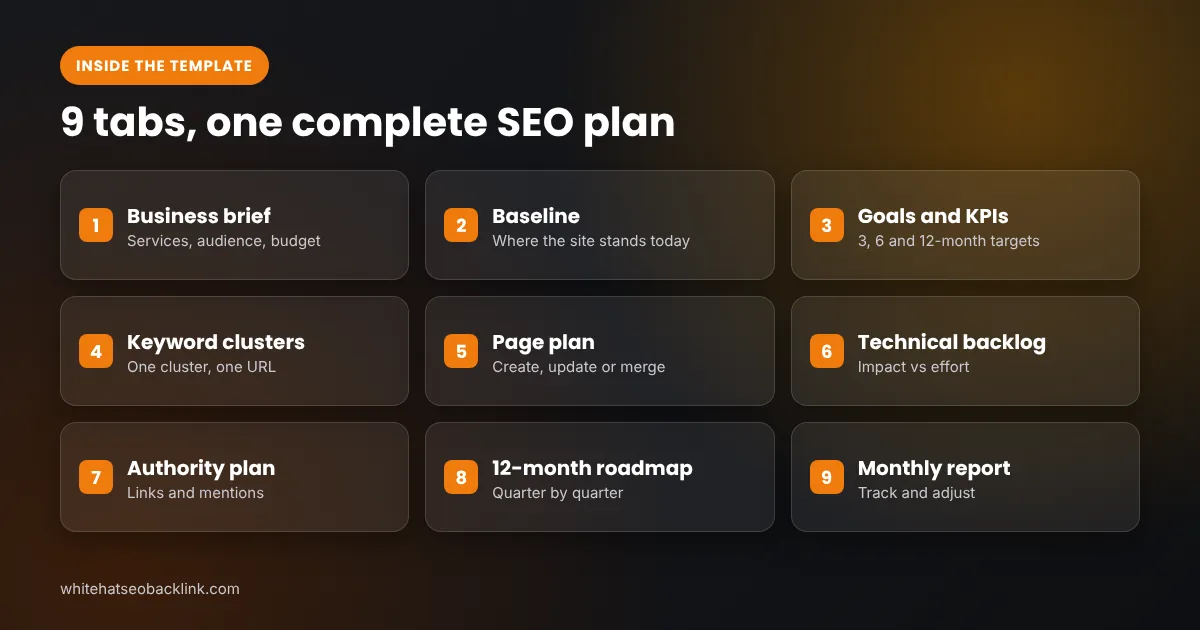
How to fill in the SEO strategy template
Work through the tabs in order. Each one depends on the answers in the tab before it.
1. Write the business brief
Start with the business, not the keywords. Record the main services, locations, ideal customer, top search competitors, budget, monthly hours and who approves content. A 30-minute call with the owner usually covers it, and it prevents months of work on topics that don’t sell anything. For agencies, this tab pairs well with your SEO client onboarding checklist.
2. Record your baseline
Capture today’s numbers before you change anything: organic clicks and impressions, organic leads, keywords in the top 3 and top 10, referring domains, indexed pages and Core Web Vitals. Add one newer metric too: how often the brand appears when you ask AI tools your customers’ key questions. Without a baseline, you can’t prove progress later.
3. Set goals and KPIs
Tie every SEO goal to a business result. “Rank higher” is not a goal; “grow organic leads from 20 to 35 per month in 12 months” is. Set targets for 3, 6 and 12 months, and give each KPI an owner. Our guide to SEO KPIs lists which metrics are worth tracking and which are vanity numbers.
4. Build keyword clusters
Pull keywords from Ahrefs or your preferred tool, then group them by meaning and intent. Each cluster gets one primary keyword, a few secondary keywords and exactly one target URL. That one-cluster-one-page rule is what stops keyword cannibalization before it starts. If you’re new to grouping, read our guide to topic clusters.
5. Plan the pages
For every cluster, decide whether an existing page should be updated, two pages should be merged, or a new page is needed. On an established site, start with a content audit, because updating pages that already have some authority is usually faster than publishing new ones. Add a writer, a due date and a link to the content brief for each row.
6. List technical fixes
Run a crawl and check Search Console, then list every issue with its impact and effort. Fix high-impact, low-effort items first: indexing problems, broken internal links, redirect chains and slow mobile pages. Use our technical SEO checklist so nothing important is missed.
7. Plan authority building
Decide how the site will earn links and mentions each month: guest posts, digital PR, local citations, reclaiming unlinked mentions or partner links. Point those links at the pages from your page plan that matter most, not just the homepage.
8. Map the 12-month roadmap
Turn everything above into a quarter-by-quarter plan. The next section shows a roadmap that works for most small and mid-sized sites.
9. Report every month
Each month, update the report tab with clicks, leads, top-10 keywords, referring domains and AI mentions, plus what was done and what’s next. Keep it short. Clients read a one-page summary; they skim a 40-page export. Our SEO report for clients guide shows how to present it.
12-month SEO roadmap template
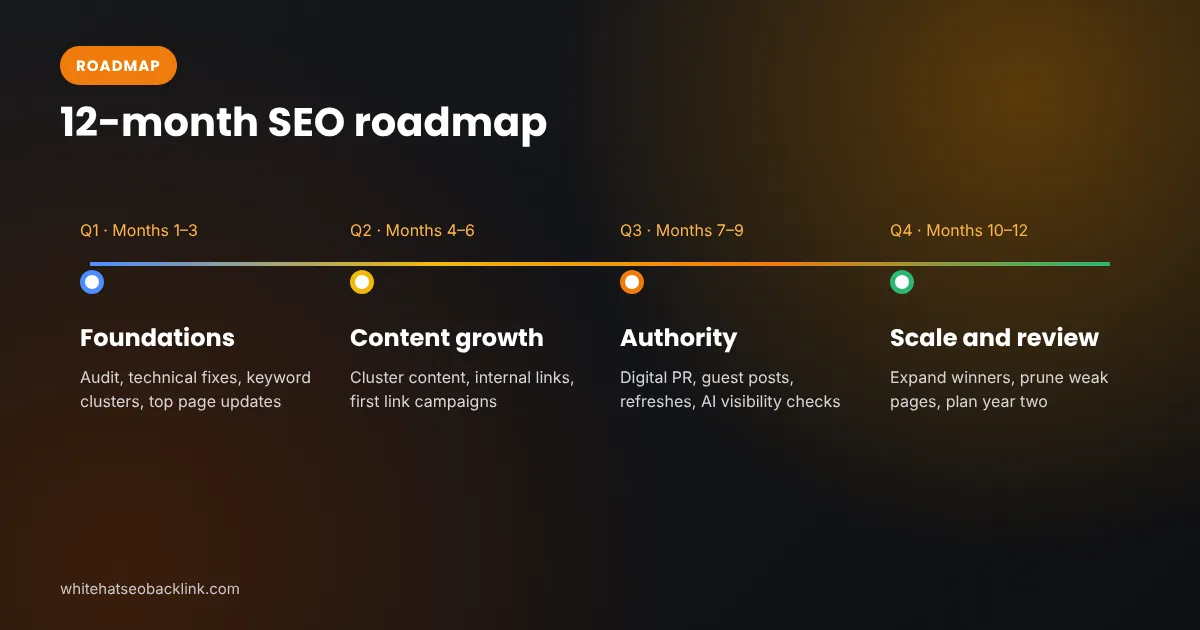
SEO compounds, so the order of work matters. This roadmap is built into tab 8 of the SEO strategy template:
|
Quarter |
Focus |
Key deliverables |
What “on track” looks like |
|---|---|---|---|
|
Q1 (months 1–3) |
Foundations |
Audit, technical fixes, keyword clusters, update top service pages |
Critical issues fixed; main pages refreshed |
|
Q2 (months 4–6) |
Content growth |
Publish cluster content, build internal links, start authority campaigns |
More keywords moving into the top 10 |
|
Q3 (months 7–9) |
Authority |
Digital PR, guest posts, refresh early content, AI visibility checks |
Referring domains and leads trending up |
|
Q4 (months 10–12) |
Scale and review |
Expand winning clusters, prune weak pages, plan year two |
12-month targets reviewed with the client |
SEO strategy template example: a local plumbing company
Here is how the SEO strategy template looks once it’s filled in. This is an illustrative example of a local plumbing business, to show the level of detail each tab needs.
|
Tab |
Example entry |
|---|---|
|
Business brief |
Emergency plumbing, water heaters and drain cleaning in Austin and three suburbs; homeowners with urgent repairs |
|
Goal |
Grow booked jobs from organic search by 40% in 12 months |
|
Keyword cluster |
“emergency plumber austin” plus “24 hour plumber” and “after hours plumber” → /emergency-plumbing/ |
|
Page plan |
Update the emergency plumbing page; create a new post on “why is my drain gurgling” |
|
Technical fix |
Service pages load slowly on mobile; compress images and remove an unused slider |
|
Authority |
Local citations, a supplier partner link and a guest post on a home improvement blog |
|
Q1 deliverables |
Technical fixes, three service page updates, Google Business Profile cleanup |
Notice that every row ties back to the goal of more booked jobs. If a task can’t be linked to the goal, it probably doesn’t belong in the first year.
How agencies can use this SEO strategy template with clients
If you run an agency or freelance, the template doubles as a client-facing plan. A few habits make it work better:
- Present it in a live call. Walk through the goals and the Q1 plan together instead of emailing a file.
- Get sign-off on goals and the keyword map. Agreement here prevents most later disputes about “what we’re paying for.”
- Share one copy. Keep a single shared file so the client always sees the current status.
- Review it quarterly. Move budget toward the clusters that are working and pause the ones that aren’t.
- Link it to pricing. The number of pages and links in the plan should match the retainer. Our guide on how to price SEO services helps you size it.
Common SEO strategy mistakes
- Choosing keywords by volume alone. High-volume terms with the wrong intent bring traffic that never converts.
- Skipping the baseline. Without starting numbers, you can’t show what the work achieved.
- Publishing before fixing technical issues. New content on a site with indexing problems may never be seen.
- Planning a year of content upfront. Plan one quarter in detail and the rest loosely, then adjust based on data.
- Forgetting AI search. More buyers ask AI tools for recommendations, so check how they describe your brand each quarter.
SEO strategy template FAQs
Final thoughts
A strategy doesn’t need to be fancy to work. It needs clear goals, honest starting numbers, one page per keyword cluster and a realistic timeline. Download the SEO strategy template, fill in the business brief today, and you’ll have a plan your whole team, or your client, can follow by the end of the week.
Want us to fill in the SEO strategy template for you?
We research your market, map every keyword cluster to the right page and hand you a 12-month plan your team can follow.