SEO Content Writing: A Simple 9-Step Process for Content That Ranks
Most people think SEO content writing means putting a keyword in a blog post ten times. That worked in 2012. Today, Google rewards pages that answer a question better than anyone else, and it is very good at spotting content written only for search engines.
Good SEO content writing is simply clear, helpful writing with a plan behind it. You pick a topic people search for, understand what they want, and give it to them in a format that is easy to read. This guide walks you through a simple nine-step process, with a before-and-after example and a checklist you can reuse for every post.
What Is SEO Content Writing?
SEO content writing is the process of planning, writing and optimising web content so that it ranks in search engines and helps the people who find it. It mixes three skills:
- Research: finding the words people type into Google
- Writing: explaining things clearly, with examples and structure
- Optimisation: making the page easy for search engines to understand
If any one of these is missing, the content struggles. Great writing on a topic nobody searches gets no traffic. Perfect keyword use on a thin page gets no rankings.
Why SEO Content Writing Still Matters
Paid ads stop the moment you stop paying. A well-written page can bring visitors for years. Strong content also supports almost everything else in marketing: your emails link to it, sales teams share it, and other sites link to it because it is useful. It is the base of a content marketing plan for small businesses.
It also matters for AI search. Clear, well-structured pages are the ones most often quoted in AI answers. Our guide on how to show up in AI Overviews explains why.
The 9-Step SEO Content Writing Process
Step 1: Choose a keyword you can actually rank for
Start with a keyword research tool and look for three things: people search for it, the difficulty score is low enough for your site, and it fits your business. New sites should aim for long-tail keywords with a difficulty under 20. For example, “seo content writing for dentists” is far easier than “content writing”.
Step 2: Read the search intent
Search your keyword and study the first page. Ask:
- Are the results guides, lists, product pages or tools?
- Are they for beginners or experts?
- What format wins: steps, comparisons, templates?
If the top ten results are all step-by-step guides, a sales page will not rank. Matching intent is the single biggest ranking factor you control.
Step 3: Find what competitors missed
Open the top five pages and list their headings. Then look for gaps: questions they skip, outdated numbers, missing examples or no visuals. Check “People also ask”, Reddit threads and forum questions for real problems. Your page should cover everything they cover, plus something they do not. Google calls this kind of extra value “information gain”.
Step 4: Build a clear outline
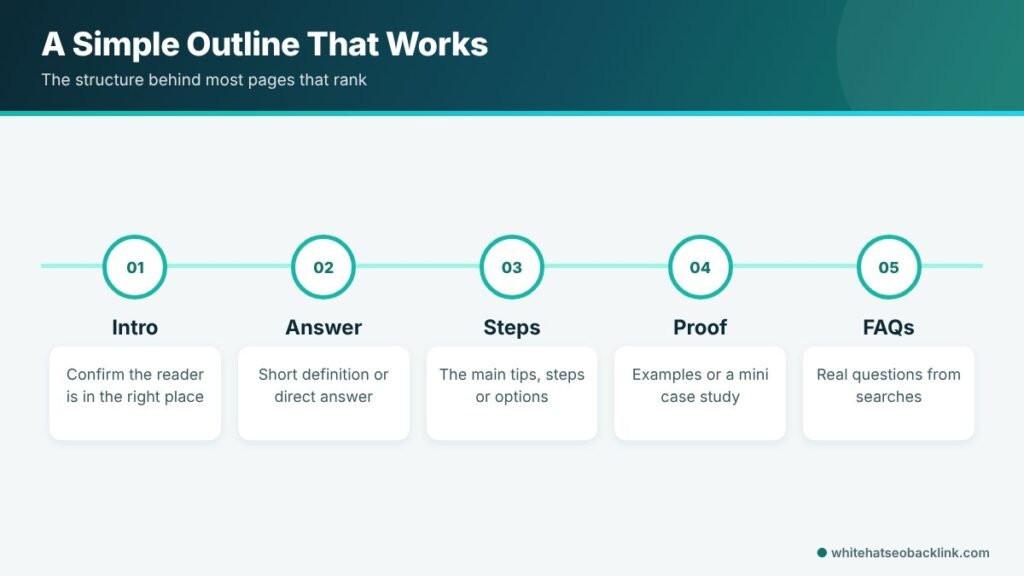
An outline saves hours. Use this simple template:
- Intro that confirms the reader is in the right place
- A short definition or direct answer
- Why it matters
- The main steps, tips or options
- Examples or a mini case study
- Common mistakes
- Summary and next step
- FAQs from real searches

Step 5: Write an intro that earns the scroll
Readers decide in seconds whether to stay. A good intro names the problem, shows you understand it, and promises a clear result. Skip long stories and dictionary definitions. Get to the point in three or four short sentences.
Step 6: Write for humans first
This is where most posts are won or lost. Follow a few simple rules:
- Use short sentences and short paragraphs (two to four lines)
- Write like you talk, using “you” and “we”
- Explain one idea per paragraph
- Use real examples, numbers and screenshots
- Cut filler phrases such as “in today’s digital world”
Aim for a reading level that a 14-year-old could follow. That is not “dumbing down”; it is respect for a busy reader.
Step 7: Place keywords naturally
Use your main keyword in the title, the URL, the first 100 words, one or two subheadings and the meta description. After that, use it where it fits naturally. A keyword density of about 1% to 1.5% is a sensible upper limit. Use related terms and synonyms too; Google understands topics, not just exact words.
Here is a quick before-and-after example:
| Before (keyword stuffing) | After (natural) |
|---|---|
| “Our SEO content writing services offer SEO content writing for businesses that need SEO content writing.” | “We write search-friendly blog posts and service pages that help small businesses get found on Google.” |
Step 8: Optimise the page
Before publishing, check the on-page basics:
- Title tag under 60 characters, with the keyword near the start
- Meta description of 140 to 160 characters that invites a click
- Headings in logical order (one H1, then H2s and H3s)
- Images compressed, with descriptive alt text
- Internal links to and from related pages, so no post becomes one of the orphan pages Google struggles to find
- External links to trusted sources where they help the reader
Step 9: Update content regularly
SEO content writing does not end at “publish”. Review important posts every six months. Refresh statistics, add new questions from Search Console, and improve sections where readers drop off. Updated pages often climb again without any new links.

Should You Use AI for SEO Content Writing?
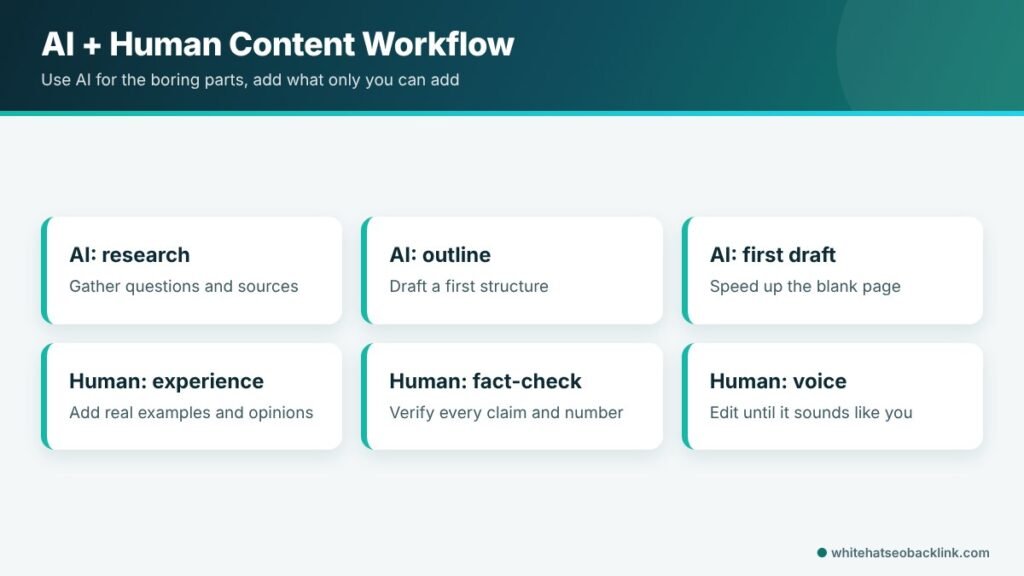
AI tools can help with research, outlines and first drafts. Google has said it rewards helpful content however it is produced. The problem is that raw AI text tends to be generic, repeats what already ranks, and sometimes states facts that are wrong.
A safe workflow is to use AI for the boring parts, then add what only you can add: your experience, your examples, your opinions and your data. Always fact-check, and always edit for your own voice. In SEO content writing, the human layer is what makes a page worth ranking.
SEO Content Writing Checklist
Use this before every post goes live:
- Keyword has search volume and fits your site’s strength
- Format matches the top results
- Covers at least one gap the competitors missed
- Direct answer appears near the top
- Short paragraphs, clear headings, lists and tables
- Keyword in title, URL, intro and one subheading
- Density at or below about 1.5%
- At least three internal links and one useful external source
- Images compressed with alt text
- Author name and a short bio
- Proofread out loud once
Common SEO Content Writing Mistakes
- Targeting keywords that are too hard. A new site will not outrank Wikipedia for “marketing”.
- Ignoring intent. Writing a guide when Google shows product pages.
- Copying the top result. Rewording what already ranks adds nothing new.
- Keyword stuffing. It reads badly and can hurt rankings.
- No internal links. Great posts that nothing links to are hard for Google to find.
- Publishing and forgetting. Old stats and broken steps slowly push a page down.
Final Thoughts
SEO content writing is not a trick. It is a habit of researching before you write, writing for the reader, and checking the details before you publish. Follow the nine steps above for your next three posts and compare their results with your older ones. The difference is usually clear within a few months.
FAQs
How long should an SEO article be?
As long as it needs to be to answer the question fully. Check the length of the top results and aim to be as complete, not simply longer.
How many keywords should I target in one post?
One main keyword and a handful of closely related ones. If two keywords need different pages, write two posts.
Is SEO content writing different from copywriting?
Yes. Copywriting aims to sell. SEO writing aims to rank and inform, though good pages often do both.
How long does it take for new content to rank?
Usually three to six months for a new site, faster for sites that already have authority.
Can I learn SEO content writing without a course?
Yes. Practise the steps in this guide, study pages that rank, and review your results in Search Console every month.