Content Gap Analysis: How to Find and Fill Missing Topics (Step-by-Step)
Your competitors are getting traffic from topics you have never written about. Some of those topics are easy wins sitting right in front of you. The trick is finding them in a structured way instead of guessing.
That is exactly what a content gap analysis does. In this guide you will learn what it is, the four types of gaps most people miss, and a simple 7-step process you can repeat every quarter, with or without paid tools.
What is a content gap analysis?
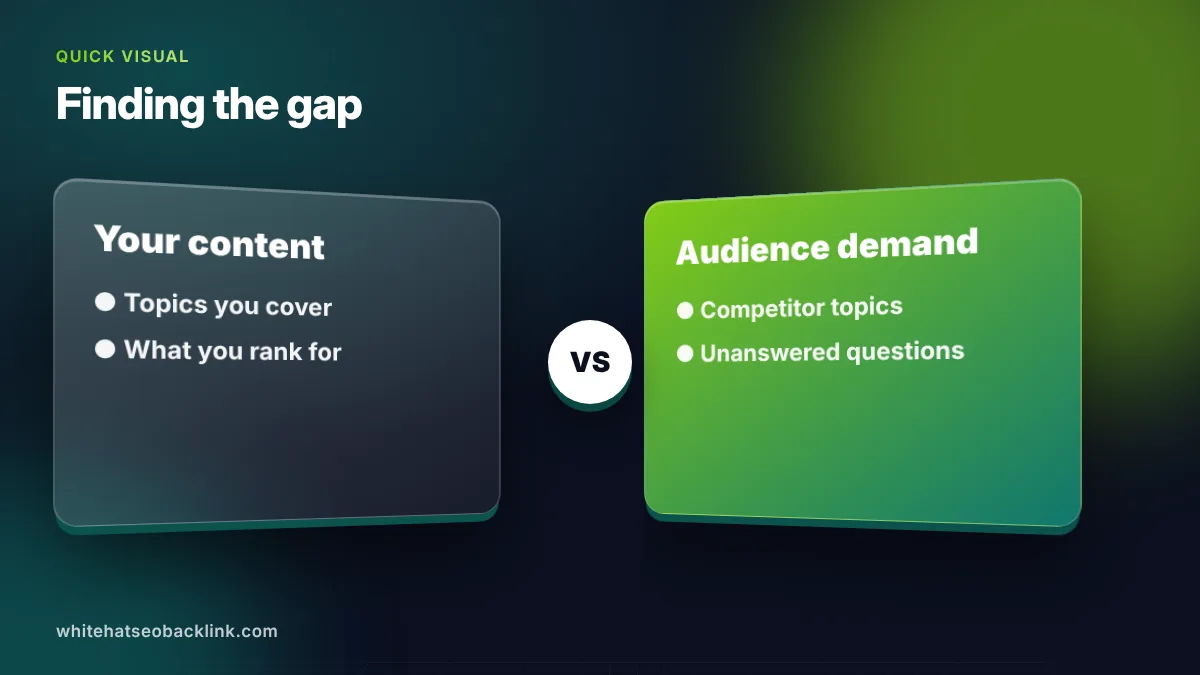
A content gap analysis is the process of comparing the content you have with the content your audience is searching for, and with what your competitors already cover. The “gaps” are the topics, keywords, questions and formats you are missing.
Think of it as a map. One side shows what people want to know. The other side shows what your site answers. Everything in between is an opportunity.
Why a content gap analysis matters for SEO
- It finds proven demand. If three competitors rank for a keyword, you know people search for it and Google rewards it.
- It saves time. You stop brainstorming in the dark and start writing pieces with a clear purpose.
- It strengthens topical authority. Filling missing subtopics tells Google you cover a subject completely, which helps every page in that cluster.
- It supports the whole funnel. You often discover you have lots of top-of-funnel posts but nothing that helps a buyer compare options or make a decision.
The 4 types of content gaps
Most guides only talk about keyword gaps. A complete review looks at all four layers.
- Keyword gaps. Search terms competitors rank for and you do not.
- Topic gaps. Whole subtopics missing from your cluster, even if no single keyword looks big.
- Funnel gaps. Missing content for a buyer stage, such as comparisons, pricing pages or case studies.
- Format and depth gaps. You cover the topic, but competitors offer a template, calculator, video or a far more detailed answer.
How to do a content gap analysis in 7 steps
Step 1: Pick your real search competitors
Your business rivals are not always your search rivals. Type your three main keywords into Google and note which domains appear again and again. In Ahrefs, the Organic Competitors report in Site Explorer lists them for you. Choose three to five sites that are similar in size to yours, because comparing yourself with giant brands produces gaps you cannot realistically win.
Step 2: Run a keyword gap report
In Ahrefs, open the Content Gap tool (in Semrush it is called Keyword Gap). Add your competitors at the top and your domain below. Set it to show keywords where at least two competitors rank in the top 10 but you do not.
Then filter the list:
- Keyword Difficulty (KD) below 30 for quick wins
- Search volume of 50 or more
- Remove branded terms and irrelevant topics

Step 3: Group keywords by search intent
A raw export of 500 keywords is overwhelming. Sort them into groups based on what the searcher wants: learn something, compare options, or buy. Several keywords usually belong on the same page, so group them under one main topic. This step also stops you from creating two pages that compete for the same term, a common side effect of a rushed content gap analysis.
Step 4: Map gaps against your existing content
Before writing anything new, check if you already have a page that partly covers the topic. Search your site with site:yourdomain.com keyword. You will end up with three buckets:
- Create: no page exists, so write a new one.
- Expand: a page exists but is thin or missing sections.
- Merge: two weak pages target the same idea, so combine them. Our guide to content pruning explains how.
Step 5: Look for topic and question gaps inside the SERP
Tools miss many gaps, so open the top three results for your main keywords and compare their headings with yours. Note every subtopic, example, table or FAQ they include that you skip. Then check People Also Ask, Reddit threads and Quora for questions nobody answers well. These “zero volume” questions often bring the most engaged readers.
Step 6: Prioritise with a simple score
Score each gap from 1 to 3 on three things: business value, ranking difficulty and effort. Start with high-value, low-difficulty, low-effort items. A spreadsheet works perfectly for this.
| Gap | Business value | Ease of ranking | Effort | Total |
|---|---|---|---|---|
| Pricing comparison page | 3 | 2 | 2 | 7 |
| Beginner how-to guide | 2 | 3 | 3 | 8 |
| Industry statistics post | 2 | 2 | 1 | 5 |
Step 7: Create, publish and link
Turn every priority gap into a clear content brief before writing. Once the piece is live, add internal links from related pages so it slots into your topic cluster and gets crawled quickly.

How to do a content gap analysis without paid tools
No budget? You can still get solid results.
- Google Search Console: Look for queries where you get impressions but sit beyond position 20. Those are topics Google already links to you but you have not covered properly.
- Google autocomplete and People Also Ask: Collect questions around your main topic.
- Competitor sitemaps: Visit competitor.com/sitemap.xml to see every page they have published.
- Customer conversations: Sales calls, support tickets and comments reveal questions no keyword tool shows.
Content gap analysis template
Copy this simple structure into Google Sheets to track your work:
| Column | What to add |
|---|---|
| Keyword or topic | The gap you found |
| Intent | Informational, commercial or transactional |
| Volume and KD | From your SEO tool |
| Competitors ranking | Which sites cover it |
| Action | Create, expand or merge |
| Target URL | Existing or planned page |
| Priority score | From step 6 |
| Status | To do, writing, live |
Common mistakes to avoid
- Chasing every keyword. Some gaps are irrelevant to your audience or impossible to win.
- Ignoring intent. If Google shows product pages, a blog post will not rank, however good it is.
- Writing duplicates. Always check existing pages first so you do not cannibalise your own rankings.
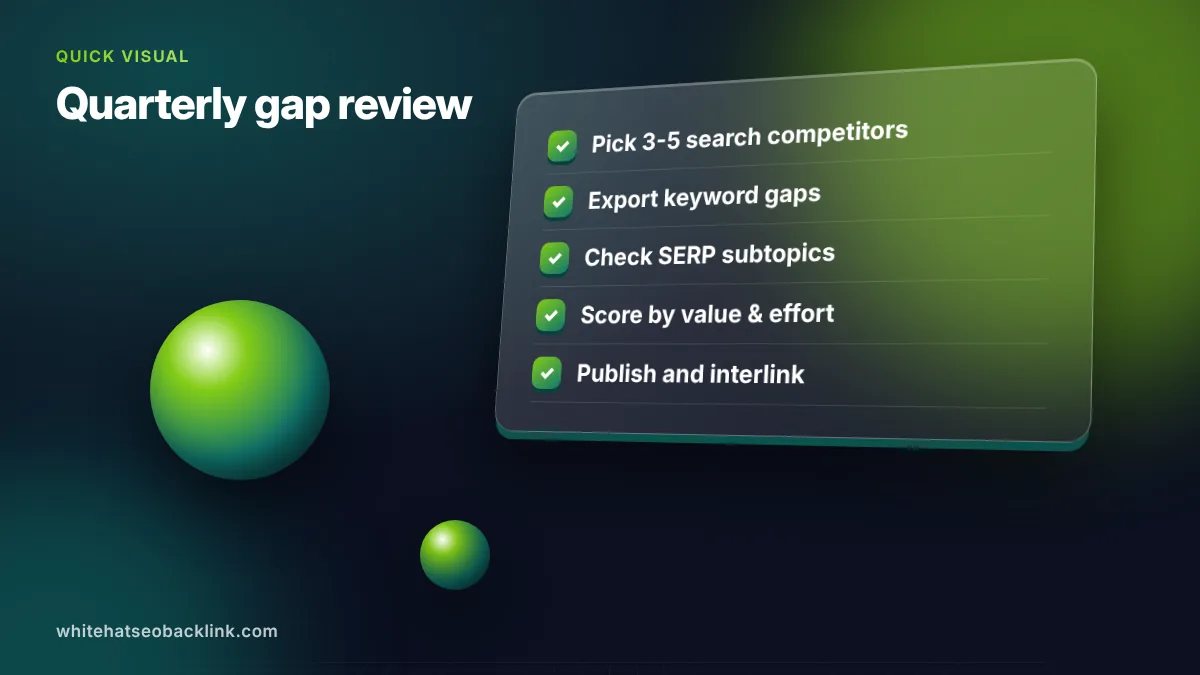
- Doing it once. Search demand changes, so repeat your content gap analysis every three to six months.
FAQs
How often should I run a content gap analysis?
Every quarter works well for most sites. Fast-moving industries, such as AI or ecommerce, benefit from a monthly light review.
What is the difference between a keyword gap and a content gap?
A keyword gap is one part of a content gap analysis. It only shows missing search terms, while a full content gap review also checks topics, funnel stages and content formats.
Which tool is best for a content gap analysis?
Ahrefs Content Gap and Semrush Keyword Gap are the most popular. Free options like Google Search Console and manual SERP checks still uncover plenty of opportunities.
Final thoughts
A content gap analysis turns content planning from guesswork into a clear to-do list. Pick realistic competitors, pull the keyword gaps, group them by intent, check what you already have, and prioritise the easy wins. Repeat it every few months and your site will steadily cover every question your audience asks, which is exactly what Google wants to reward.