Resource Page Link Building: How to Find, Qualify and Pitch Resource Pages
Some web pages exist for one reason: to send people somewhere else. Libraries, universities, local councils, bloggers and trade groups all publish “useful links” pages to help their readers. Those pages are called resource pages, and they are one of the easiest places to earn a genuine backlink.
Resource page link building is simple. You find pages that already list helpful links on your topic, check that your content would truly help their readers, and ask the owner to add it. No guest post, no payment, no tricks.
In this guide you will learn how to find good resource pages, how to judge them in under two minutes, what kind of content gets added, and exactly what to write in your email.
What Is a Resource Page?
A resource page is a curated list of links on one topic. You will often see titles like “Helpful Resources”, “Useful Links”, “Further Reading” or “Recommended Tools”. Good resource pages are maintained by real people who care that their visitors find accurate, useful information.
Because the whole point of the page is to link out, the owner is already open to adding new links. You just need to show them something that deserves a spot.
Why Resource Page Link Building Is Worth Your Time
- High acceptance rates. You are asking for exactly what the page is built for.
- Strong topical relevance. Every link on the page is about the same subject as yours.
- Trusted domains. Many resource pages sit on .edu, .gov, library and nonprofit sites.
- Long life. Resource pages are rarely deleted, so links tend to last for years.
- Real referral traffic. People actually click these links because they came looking for help.
Links like these are a big part of why relevant backlinks build authority faster than random links from unrelated sites.
Step 1: Create Content That Wins at Resource Page Link Building
This is where most people fail. Resource page owners do not link to sales pages. They link to things that help. Before you send a single email, make sure you have at least one of these:
- A complete beginner guide or how-to tutorial
- A free checklist, template or calculator
- A glossary of terms in your industry
- Original data, a survey or a local study
- A clear comparison or “how to choose” guide
Not sure what to create? Our content marketing plan for small businesses helps you find topics people actually want.
Step 2: Find Resource Pages With Search Operators
Google search operators are the fastest free way to start resource page link building and find resource pages. Swap “keyword” with your topic:
| Search string | What it finds |
|---|---|
keyword inurl:resources | Pages with “resources” in the URL |
keyword intitle:"useful links" | Classic link list pages |
keyword "helpful resources" | Pages mentioning helpful resources |
keyword intitle:resources site:.edu | University resource pages |
keyword "further reading" | Article roundups with outbound links |
keyword inurl:links.html | Older but often still maintained link pages |
Tip: Add your city or region to the search if you serve a local area. Local resource pages convert very well and also support local link building.

Step 3: Use Your Competitors’ Backlinks
If a competitor has a guide similar to yours, check its backlinks in Ahrefs, Semrush or Moz. Filter the results by words like “resources” or “links” in the referring URL. These pages already link to content like yours, so they are warm prospects. Our walkthrough on finding competitors’ backlinks explains how.
Step 4: Qualify Each Resource Page in 2 Minutes
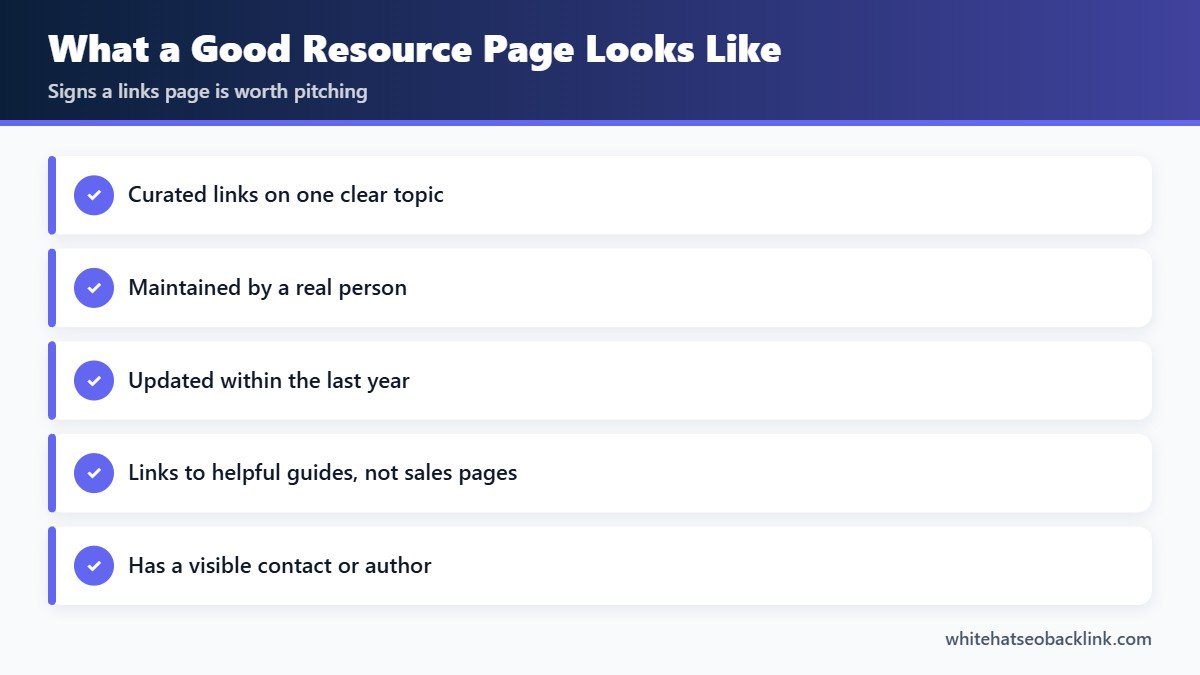
Not every list deserves your time. Smart resource page link building is about quality, not volume. Use this quick check before adding a page to your outreach sheet:

- Is it updated? Look for recent dates or links to recent content. Dead pages rarely get edited.
- Is it relevant? Your page should fit naturally beside the existing links.
- Is it a real list? Avoid pages with hundreds of random links or obvious paid placements.
- Does the site have traffic? A quick look in your SEO tool tells you if Google trusts it.
- Can you find a contact? No contact, no link. Move on.
Want a deeper check? Use our site quality checklist. The same rules apply.
Step 5: Look for Broken Links While You Are There
Resource pages collect dead links over time. Run a broken link checker on each page. If you find a dead link that matches your content, mention it in your email. You are now helping, not just asking, which often doubles the chance of a reply. Our broken link building guide covers this method in full.
Step 6: Write a Short, Personal Pitch
Keep your resource page link building email short and focused on their readers. Here is a template you can adapt:
Subject: A resource for your [topic] page
Hi [Name],
I came across your [page title] page while researching [topic]. The section on [specific detail] was really helpful.
I recently put together [your resource], which covers [one-line benefit]. It might be a useful addition for your readers: [URL]
Either way, thanks for maintaining such a helpful list.
[Your name]
More outreach examples are in our outreach email guide.
Step 7: Follow Up and Track Results
Wait about a week, then send one polite follow-up. Track each page, contact, date and outcome in a spreadsheet. After 30 to 50 pitches you will see which content and which types of sites respond best, so you can focus your time there.
Resource Page Link Building Examples by Industry
Resource page link building works in almost every niche. The trick is matching your best content to the kind of pages your industry already curates:
| Industry | Resource pages to target | Content that gets added |
|---|---|---|
| Home services | Local council and homeowner guides | Seasonal maintenance checklists |
| Health and fitness | University and nonprofit wellness pages | Plain-language guides and calculators |
| SaaS and tech | Developer and student tool lists | Free tools, templates and tutorials |
| Finance | Library and community money guides | Budget templates and explainers |
| SEO and marketing | Marketing course and blog resource lists | Checklists, glossaries and original data |
DIY vs Hiring a Resource Page Link Building Company
If you have a few hours a week, DIY resource page link building is very doable with the steps above. As your site grows, the research and outreach can take over your schedule. That is when a white-hat resource page link building company or agency makes sense. Ask any provider for real example links, how they qualify resource pages and whether they ever pay for placements. If the answer to the last question is yes, walk away.
Resource Page Link Building Mistakes to Avoid
- Pitching your homepage or service page instead of a helpful resource
- Paying for a spot on a “resource” page (that is a paid link, not an earned one)
- Ignoring the page’s audience, such as pitching business tools to a student help page
- Sending the same template to every site without one personal line
- Using exact-match anchor text requests (let the owner choose)
Resource Page Link Building vs Other Link Building Methods
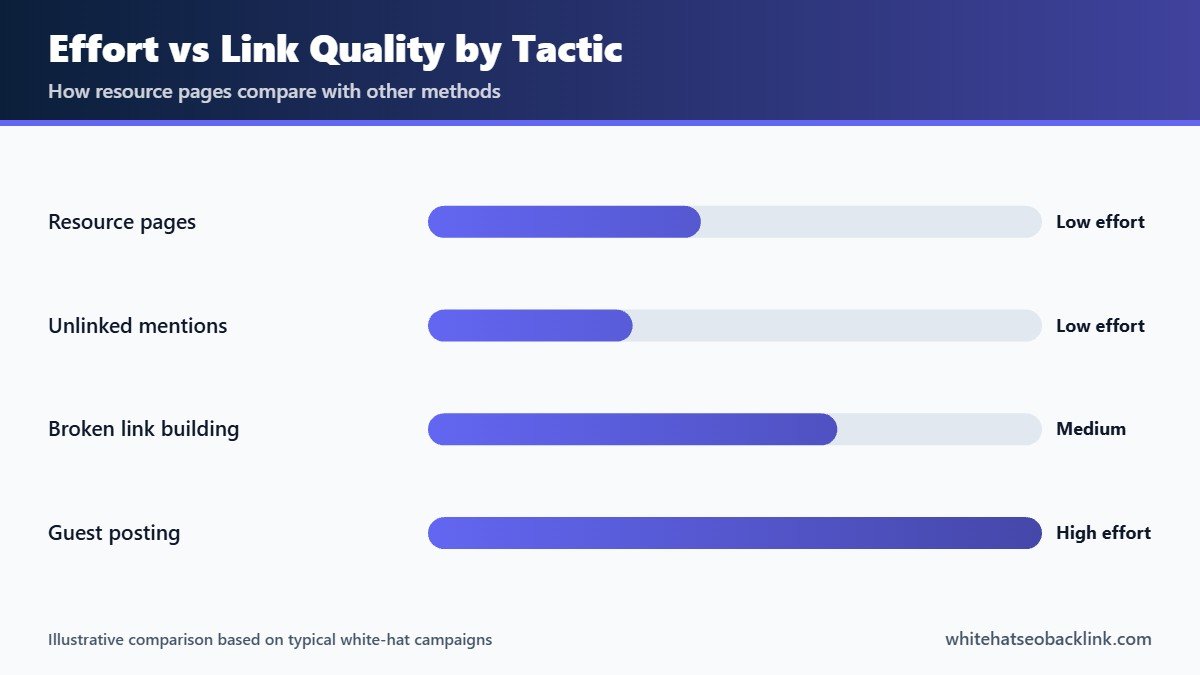
| Method | Effort | Typical acceptance | Main benefit |
|---|---|---|---|
| Resource pages | Low to medium | Higher than cold outreach | Relevant, long-lasting links |
| Broken link building | Medium | Medium | Helps owners fix errors |
| Guest posting | High | Varies | Brand reach and authority |
| Unlinked mentions | Low | High | Turns mentions into links |
Resource page link building works best as one part of a balanced plan. For the full picture, read our guide on how to get backlinks in 2026.
Frequently Asked Questions
Is resource page link building still valuable in 2026?
Yes, when the page is relevant, maintained and links to quality sites. Avoid huge link farms that list anything.
Do I need an .edu resource page to benefit?
No. A relevant industry blog or local organization page can help just as much. Relevance matters more than the domain extension.
How long until I see results?
Links usually get added within days or weeks of a yes. Ranking impact depends on your competition and overall link profile, so expect gradual gains over a few months.
Final Thoughts
Resource page link building is one of the most beginner-friendly, white-hat tactics you can use. Build one truly helpful asset, find the pages that already curate links on your topic and send short, honest emails. Repeat it every month and your link profile will grow steadily and safely.
If you would rather have experts handle prospecting and outreach, our team builds white-hat links for businesses and agencies. See what link building costs to plan your budget.