Guest Posting Services: How to Choose One That Builds Real Authority
Search for guest posting services and you’ll find thousands of offers. Some promise 50 links for $25. Others charge $500 for one placement. On the surface they look the same, which makes it hard to tell who sells real value and who sells a future cleanup job.
This guide shows how guest posting services work, how to vet the sites they use, what fair pricing looks like and the questions to ask before you pay anyone.
What Are Guest Posting Services?
Guest posting services write articles and get them published on other websites in your industry, with a contextual link back to your site. Instead of spending weeks finding blogs, pitching editors and writing content yourself, you pay a team to run the whole process.
A typical service covers:
- Finding relevant websites that accept guest contributions
- Pitching topics to editors
- Writing an original article for each site
- Placing a natural link to your page inside the content
- Sending a report with every live URL

Why Businesses Use Guest Posting Services
Done properly, guest posting brings three benefits that are hard to get any other way.
- Authority. Links from trusted, relevant sites help Google see your pages as credible.
- Referral traffic. A useful article on a popular blog sends visitors who already care about your topic.
- Brand visibility. Your name appears in front of new readers, and mentions on trusted sites also help AI tools like ChatGPT, Perplexity and Google AI Overviews understand what your brand is known for.
The catch is time. Many site owners send hundreds of emails to land a handful of placements, which is why most turn to guest posting services instead.
Outreach-Based vs Network-Based Providers
This is the most important thing to understand before you buy.
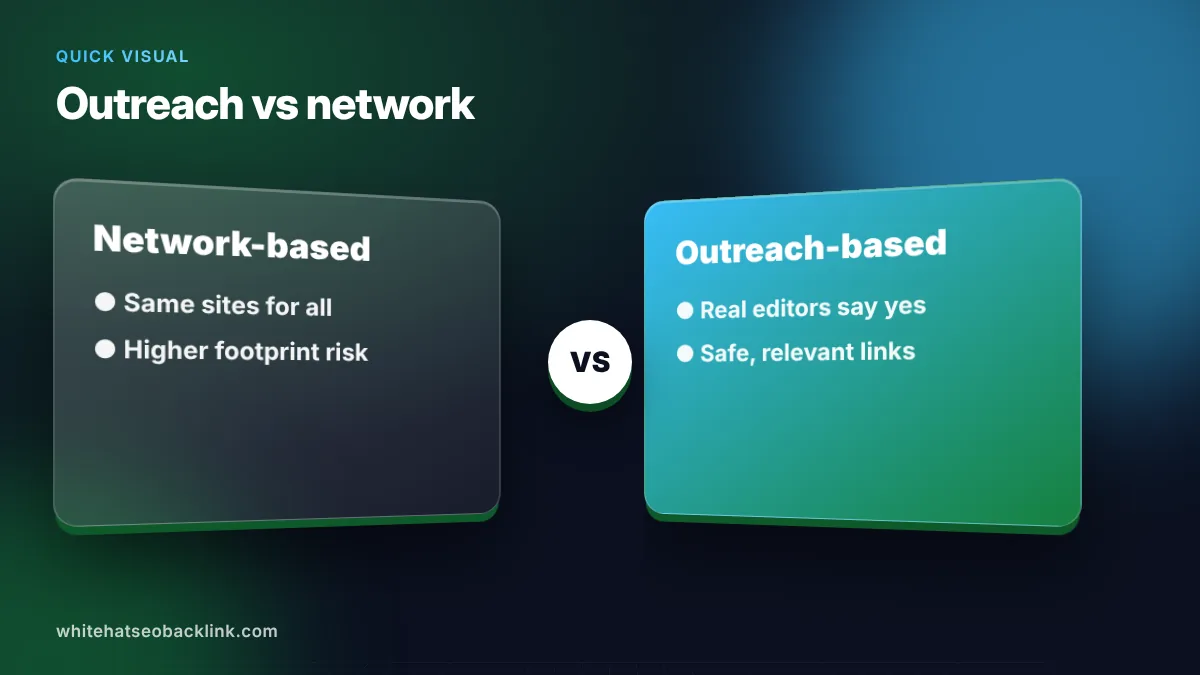
Outreach-based (white hat). The provider contacts real site owners one by one, pitches a topic that suits their audience and gets the article approved by an editor. These sites have real readers. It takes longer and costs more, but the links are safer and stronger.
Network-based (risky). The provider owns or rents a list of sites that publish almost anything for a fee, often private blog networks (PBNs) or link farms. They have little real traffic, cover every topic under the sun and exist mainly to sell links.
If a provider can deliver dozens of links in a few days at a very low price, you’re almost certainly looking at a network.
10-Point Checklist to Vet Any Guest Post Site
Good guest posting services will let you check every site before publishing. Use this checklist.
- Organic traffic. Check the trend in Ahrefs or Semrush. You want steady growth, not a spike or a sudden crash.
- Domain Rating and Domain Authority. Ahrefs DR and Moz DA are useful filters, but never the only ones, because both can be inflated.
- Trust Flow vs Citation Flow. In Majestic, a Trust Flow far below Citation Flow often means a lot of low-quality links.
- Spam Score. A high Moz Spam Score is a warning sign worth investigating.
- Topical relevance. The site should cover your niche, not crypto, recipes and pets on the same homepage.
- “Write for us” price lists. Sites that publicly advertise paid posts are easy for Google to spot. Avoid them.
- Content quality. Read three recent posts. Are they useful, edited and written for people?
- Publishing frequency. A healthy blog posts regularly. One that publishes 20 sponsored posts a day doesn’t.
- History. Use the Wayback Machine (archive.org) and WHOIS history to spot expired domains rebuilt as link sellers.
- Outbound links. Too many outbound links per post, or links to casino and adult sites, is a link-farm footprint.
Red Flags to Avoid
Walk away if a provider shows any of these signs:
- Huge link packages at prices that seem too good to be true
- Guaranteed rankings or guaranteed traffic
- Sites with high DR but almost no organic traffic
- No samples, no site list and no approval before publishing
- Thin, generic or spun articles
- No replacement policy if a link is removed
How Much Do Guest Posting Services Cost?
Prices depend on site quality and how much work goes into each placement.
| Tier | Typical price per post | What you usually get |
|---|---|---|
| Very cheap | Under $40 | Network sites with little traffic, best avoided |
| Direct outreach | $80 – $150 | Real DR 40+ blogs bought direct from publishers, without reseller markup |
| Agency mid-range | $150 – $400 | Relevant blogs with steady traffic and editorial review |
| Premium | $500+ | Well-known industry sites with strong authority |
The price normally includes outreach, writing and publication. For a full breakdown by DR, traffic and method, read our guide on how much link building costs.

12 Questions to Ask Before You Hire
- Do you use manual outreach or a network of sites?
- Can I see recent placements in my niche?
- Can I approve each site before publishing?
- What minimum organic traffic do your sites need?
- Who writes the articles, and can I review them?
- How do you choose anchor text?
- Are links dofollow, and are any marked rel=”sponsored”?
- How long do placements stay live?
- What happens if a link is removed?
- How long does delivery take?
- What does your report include?
- Do you work with sites in my country and language?
A strong provider answers every one of these clearly and without hesitation.
Is Buying Guest Posts Against Google’s Rules?
Google’s guidelines say paid links should carry a rel=”sponsored” or rel=”nofollow” attribute, and its spam policies target large-scale link schemes. The real risk comes from volume-driven networks built only to manipulate rankings. Earning placements on relevant sites with genuinely useful content is very different, and trustworthy guest posting services focus on editorial quality and relevance rather than volume.
How to Get the Best Results
- Link to pages that deserve it. Helpful guides and key service pages work better than thin pages.
- Spread links over time. A steady pace looks more natural than 30 links in one week.
- Vary anchor text. Mix branded, partial-match and URL anchors (see anchor text diversity).
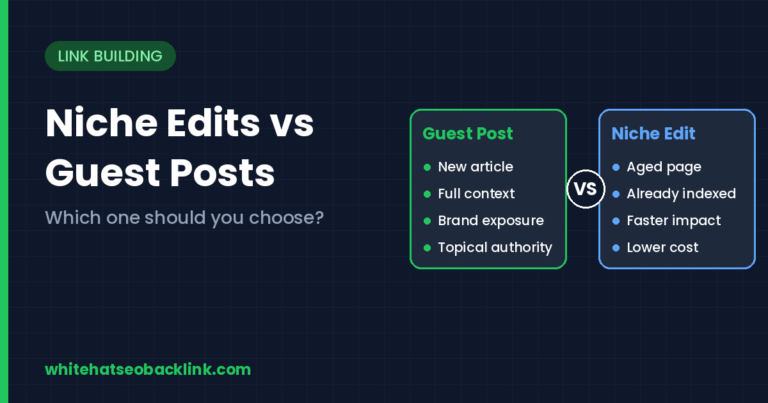
- Combine link types. Compare niche edits vs guest posts to see how they fit together.
- Track results. Watch rankings, organic traffic and referral visits for each target page.

How Long Until You See Results?
Guest post links usually take a few weeks to be crawled. Most sites see ranking improvements in two to four months, depending on competition. To estimate how many you need, read how many backlinks do I need to rank.
Frequently Asked Questions
Are guest posting services safe?
Yes, when the provider uses manual outreach on real, relevant sites with genuine traffic. Providers built on cheap link networks carry much higher risk.
How many guest posts do I need each month?
It depends on your competition and budget. Many small businesses start with 4 to 8 quality placements a month and adjust from there.
Do guest post links expire?
Most quality placements are permanent, but sites change. Good providers replace a link if it’s removed within a set period.
What’s the difference between guest posting and link building?
Guest posting is one type of link building. Link building also includes niche edits, digital PR, broken link building and resource page links.
Final Thoughts
The right guest posting services save you time and build authority that lasts. The wrong ones waste money and leave links you’ll want to remove. Focus on relevance, real traffic, original content and transparency, and never choose on price alone.
Want placements on real, relevant websites earned through manual outreach? Start with a $50 trial post or see our link building services.