Guest Posting Outreach: How to Pitch Editors and Get Yes Replies (2026)
Finding sites that accept guest posts is the easy part. Getting an editor to actually reply is where most people fail. Editors receive dozens of lazy, copy-paste pitches every week, and they delete almost all of them.
This guide shows you how to do guest posting outreach the right way. You will learn how to find the right person, write a short pitch that gets noticed, follow up without being annoying, and track results so every campaign gets better than the last.
What is guest posting outreach?
Guest posting outreach is the process of contacting website owners or editors to pitch an article you will write for their site. In return, you usually get an author bio or a contextual link back to your website, plus exposure to a new audience.
It sits between two steps. First you find guest posting sites. Then, once a pitch is accepted, you write the article following their guest posting guidelines. Outreach is the bridge that connects the two, and it decides whether you land one post a month or ten.
Why most outreach emails get ignored
Before writing your first pitch, know what editors hate:
- Generic openers like “Dear Sir/Madam, I love your blog.”
- No topic ideas, just “Can I write for you?”
- Pitching topics they already covered last month.
- Asking for do-follow links in the first email.
- Long emails that take more than 30 seconds to read.
Fix these five things and your reply rate will already beat most competitors.
Prepare before you send a single email
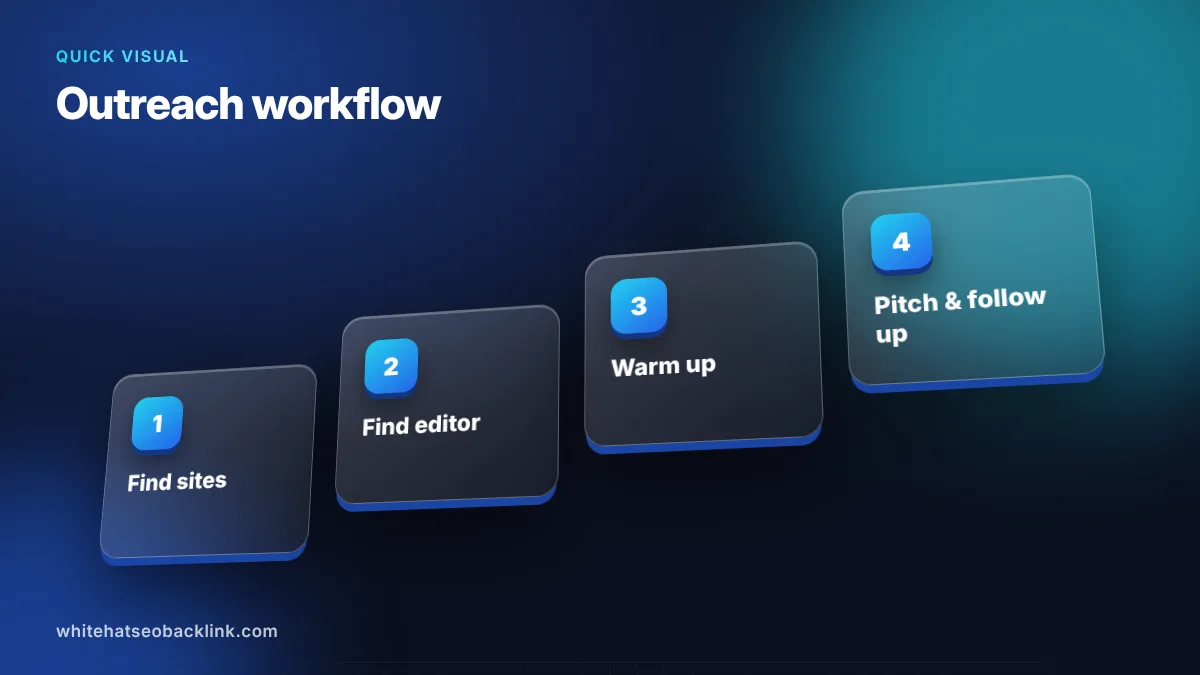
Build a qualified prospect list
Quality beats quantity in guest posting outreach. Before adding a site to your list, check that it has real organic traffic, a relevant audience and a history of publishing guest authors. Our checklist on how to check guest post site quality walks through the signs of a healthy site versus a link farm.
Find the right contact
Sending your pitch to info@ or a contact form is the slowest route. Look for the content manager, editor or blog lead instead. Good places to check:
- The “Write for us” or contributor page
- Author bylines on recent posts
- The team or about page
- LinkedIn, searching “editor” plus the site name
- Email finder tools like Hunter or Snov.io
Warm up the relationship
A small step most guides miss: engage before you pitch. Share one of their articles on LinkedIn or X, leave a thoughtful comment, or mention them in your own content. When your email arrives a week later, your name already looks familiar.

How to write a guest post pitch that gets replies
Good guest posting outreach emails are short, personal and focused on the editor’s readers, not your link. Follow this structure:
- Subject line: clear and specific, such as “Guest post idea: 7 local SEO mistakes for dental clinics.”
- Personal opener: one line proving you read their site.
- Who you are: one sentence on your expertise.
- Two or three topic ideas: each with a one-line angle.
- Proof: links to one or two published samples.
- Easy close: a simple yes or no question.
Guest post pitch template
Subject: Article idea for [Site name]: [Topic]
Hi [First name],
I enjoyed your recent piece on [article title], especially the point about [specific detail].
I’m [Name], [role] at [Company], where I help [audience] with [topic]. I’d love to contribute an original article for your readers. A few ideas:
- [Headline 1]: [one-line angle]
- [Headline 2]: [one-line angle]
- [Headline 3]: [one-line angle]
Here are two of my recent articles: [link 1], [link 2].
Would any of these be a good fit?
Thanks, [Name]
Customise every bracket. If an email could be sent to 100 sites without changes, it is not personal enough.
How to choose topic ideas editors accept
- Look for content gaps on their site using a quick content gap check or a
site:search. - Bring unique experience, such as data, a case study or a process you actually use.
- Match their format, whether that is listicles, how-to guides or opinion pieces.
- Avoid sales angles. Editors reject anything that reads like an advert for your company.
Follow-up emails that work without annoying anyone
In guest posting outreach, many replies come from the follow-up, not the first email. A simple sequence:
| When to send | What to say | |
|---|---|---|
| Pitch | Day 1 | Personal pitch with 2 to 3 ideas |
| Follow-up 1 | Day 4 or 5 | Short nudge, maybe a new idea |
| Follow-up 2 | Day 10 to 12 | Polite final check-in, then close the loop |
Stop after two follow-ups. Pushing harder damages your reputation and can get your domain marked as spam.

Track your guest posting outreach
Keep every contact in a simple spreadsheet or a tool like Pitchbox, BuzzStream or Respona. Track:
- Site, contact name and email
- Date of pitch and follow-ups
- Status (sent, replied, accepted, published, declined)
- Topic agreed and deadline
- Live URL and link type
Then review your numbers every month. A healthy campaign usually sees a 10% to 20% reply rate and a 5% to 10% acceptance rate. If you are below that, tighten your prospect list or rewrite your pitch.
Guest posting outreach etiquette and safety tips
- Never pay for links on sites that hide it. Google treats paid links without proper attributes as a spam signal.
- Do not mass-blast hundreds of emails from your main domain. Use a separate sending domain and warm it up first.
- Deliver on time. Late or low-quality drafts burn bridges with editors.
- Write original content. Never reuse or spin an article you published elsewhere.
If guest posting outreach feels too time-consuming, a vetted white hat guest post service can handle prospecting and pitching for you while keeping quality high.

FAQs
How many guest posting outreach emails should I send per day?
For a new sending domain, stay under 30 to 50 personalised emails per day. Quality and personalisation matter far more than volume.
Should I mention backlinks in my pitch?
No. Focus on the value to their readers. Discuss your author bio or a contextual link only after the editor accepts your topic.
Is guest posting outreach still worth it in 2026?
Yes. Done well, it builds relevant links, brand mentions and authority, all of which help both Google rankings and visibility in AI search tools.
Final thoughts
Successful guest posting outreach is about relevance and respect. Build a tight list of quality sites, find the real editor, warm them up, pitch two or three strong ideas, and follow up politely. Track every email, learn from the numbers, and you will turn cold pitches into a steady stream of published posts.