Guest Post Pricing: How Much Do Guest Posts Cost in 2026? (Real Ranges)
Ask ten site owners what a guest post costs and you may get ten different answers. One blog asks $50, another asks $800, and a big media site may want thousands. So what is a fair price, and how do you avoid paying for links that do nothing, or worse, hurt your site?
This guide breaks down guest post pricing in simple terms. You will see typical price ranges, what makes one post cost more than another, the hidden costs most buyers forget and a quick checklist to judge any offer.
Why guest post prices vary so much
The first thing to understand about guest post pricing is that a guest post is not one standard product. Price depends on the site, the content and who does the work. Two posts that look the same on paper can have very different value.
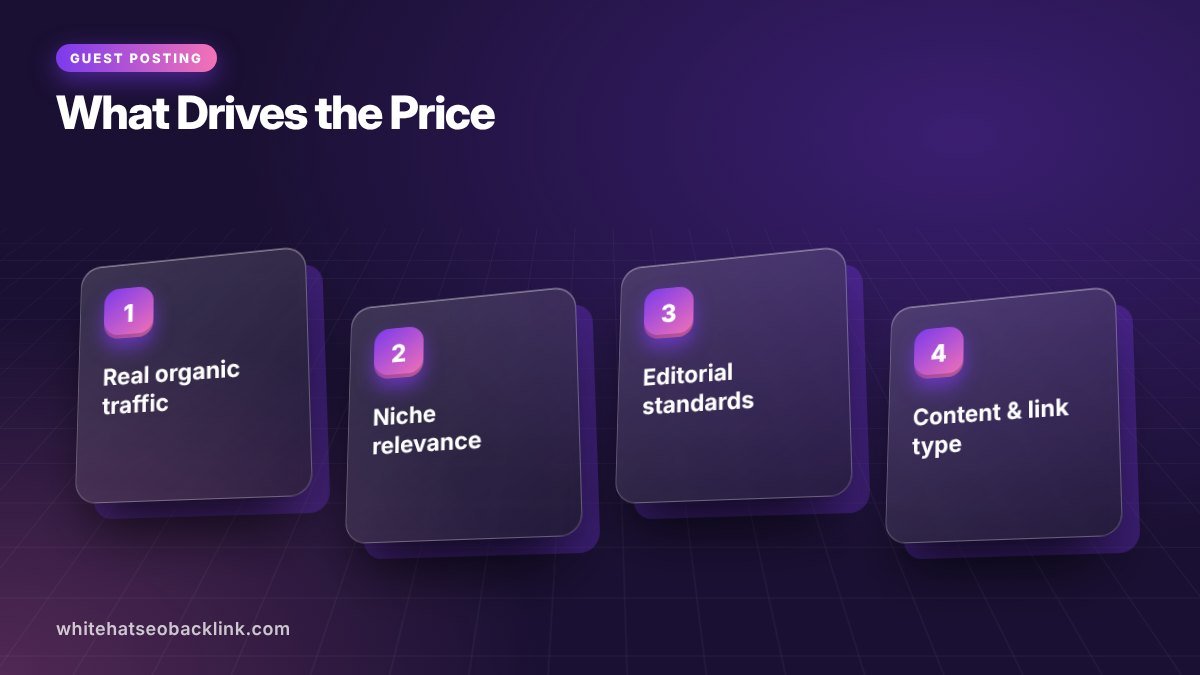
The biggest factors are:
- Real organic traffic of the site (not just authority scores)
- Niche relevance to your business
- Editorial standards, such as strict editing and real review
- Content creation, whether you write it or the site does
- Link type and placement, including in-content links versus author bio links
- Who sells it: the site owner directly, an outreach agency or a marketplace reseller
Typical guest post pricing ranges
These are rough ranges for 2026, based on common market rates. Prices vary by niche and region.
| Site level | Typical monthly organic traffic | Typical price per post |
|---|---|---|
| Small niche blog | Under 1,000 | $30 – $100 |
| Growing niche site | 1,000 – 10,000 | $100 – $300 |
| Established industry site | 10,000 – 100,000 | $300 – $1,000 |
| Major publication | 100,000+ | $1,000 – $5,000+ |
Competitive niches like finance, legal, health, crypto and software usually cost more. Some site owners also charge extra for “sensitive” topics or charge per link rather than per post.
What is included in the price?
Before comparing offers, check exactly what you are paying for. Good guest post pricing usually includes:
- Article writing (or editing of your draft)
- Publishing on a real, indexed page
- One or two contextual links
- Permanent placement, or a clear time period
- A live URL report after publishing
If writing is not included, add the cost of a skilled writer. A quality 1,200-word article from a niche writer often costs $60–$200 on its own.

Hidden costs buyers forget
The headline price is rarely the full cost. Watch for:
- Content fees when the site requires its own writers
- Extra link fees for a second link or a money-page link
- Rush fees for faster publishing
- Agency markups when a reseller sits between you and the site
- Your time spent on outreach, follow-ups and checking live links
- Replacement risk if the post is removed or the link changes
Adding these up gives you the real cost per link, which is the number that matters. Comparing guest post pricing without these extras is like comparing car prices without tax and delivery.
DIY outreach vs agency vs marketplace
| Option | Cost | Pros | Cons |
|---|---|---|---|
| Do it yourself | Mostly time | Full control, real relationships | Slow, needs skill |
| Outreach agency | Higher per post | Saves time, vetted sites | Markups, less control |
| Marketplace | Lower upfront | Fast, many options | Mixed quality, spam risk |
Many small businesses start with DIY outreach and move to a trusted agency as they grow. Our guide on how to find guest posting sites helps if you want to do it yourself.
How to judge whether a price is fair
Use this quick checklist before you pay:
- Check real traffic. Use an SEO tool to see organic traffic and its trend. A falling graph is a warning sign.
- Check relevance. Does the site write about your topic regularly?
- Look at other posts. If every article has random outbound links to casinos, loans and pills, avoid it.
- Check if posts get indexed. Search Google for a few recent guest posts. If they are not indexed, your link may never count.
- Ask about labelling. Paid links should be marked rel=”sponsored” under Google’s rules.
- Compare cost per visitor. A $300 post on a site with real readers can beat a $50 post on a dead one.

Guest post pricing and Google’s rules
This is the part many sellers avoid. Google treats links that are paid for as link schemes unless they are marked with rel=”sponsored” or rel=”nofollow”. Large-scale guest posting campaigns with keyword-rich anchor text are also a known spam pattern.
That does not mean all guest posting is bad. Writing helpful articles for relevant sites builds authority, traffic and brand awareness. It just means you should focus on quality, relevance and real readers rather than chasing cheap links. Our post on guest posting for SEO explains the safe approach in detail.
What competitors usually miss
Most articles on guest post pricing only list numbers. A few important points rarely get covered:
- Price per referral visit. Some buyers track how many real visitors each post sends. It is a great quality filter.
- Link lifespan. A cheap post removed after six months costs more per month than a pricier permanent one.
- Content quality cost. A great article can attract its own links and shares, adding value on top of the placement.
- Negotiation. Site owners often offer discounts for multiple posts, longer lead times or high-quality content you supply.
Red flags in guest post offers
- Huge lists of “high DA” sites for very low prices
- Sites with traffic that dropped sharply after a core update
- “Write for us” pages on sites with no clear topic
- Guaranteed “dofollow forever” promises with no labelling
- Sellers who refuse to show sample live posts
- Prices that never change, no matter the niche or link

Guest post pricing by niche
Niche has a big effect on cost. Here is how guest post pricing tends to shift across common industries:
- Tech, SaaS and marketing: many sites, strong demand. Expect mid to high prices on sites with real readers.
- Finance, insurance and legal: high-value keywords mean site owners charge a premium, often two to three times the price of general niches.
- Health and wellness: editors are stricter because of YMYL content rules, so prices and review times both go up.
- Home, travel and lifestyle: lots of supply, so prices are usually lower, but quality varies widely.
- Local business sites: small local blogs and news sites are often affordable and very relevant for local SEO.
Use these as a guide, not fixed rules. The best way to understand guest post pricing in your niche is to contact ten relevant sites and compare their replies.
How to budget for guest posts
Start small. Pick five to ten highly relevant sites, set a test budget and track results for three months. Measure traffic, referral visits and ranking changes on target pages. Then put more budget into the sites and content types that work. Review your guest post pricing data every quarter so you keep paying for results, not habits.
For a wider view of link costs, see how much link building costs to compare guest posts with other methods.
FAQ
What is the average guest post price?
For most real niche sites with steady traffic, guest post pricing sits between $100 and $500 per post. Major publications cost much more.
Are cheap guest posts worth it?
Usually not. Very cheap posts often sit on low-quality sites built to sell links. They may not be indexed and can create risk.
Should guest post prices include content?
Ideally, yes. If not, budget for a skilled writer so the article is genuinely useful to readers.
Final thoughts
Fair guest post pricing depends on real traffic, relevance and quality, not on a single authority score. Look at the full cost per link, avoid obvious link farms, follow Google’s labelling rules and invest in sites your customers actually read. Spend a little more on the right sites and you will get far more value from every post.