Content Marketing for Small Business: A Simple Plan You Can Run in 4 Hours a Week
Most small business owners know they “should be doing content”. Then real life happens. Orders, staff, invoices, a website that hasn’t been touched in a year. The blog has three posts, and the last one is from two summers ago.
Content marketing for a small business doesn’t need a content team, a huge budget or daily posting. It needs a clear focus, a simple routine and content that answers what your customers already ask you. This guide gives you a plan you can run in about four hours a week.
What content marketing means for a small business
Content marketing is creating useful content (articles, guides, videos, checklists, emails) that helps your ideal customers, so they find you, trust you and eventually buy from you.
For a small business, the goal is not going viral. It’s simpler:
- Show up in Google when local or niche customers search for help.
- Answer questions before people call, so the right leads come in.
- Build trust so you don’t have to compete only on price.
- Give your sales, social media and email something useful to share.
Big brands write to be seen. Small businesses should write to be chosen.
Why it works so well for small businesses
You have one big advantage over large competitors: you know your customers personally. You hear their real questions every week. Big brands pay agencies to guess what you already know.
Content also keeps working. A good article you publish this month can bring visitors for years, while a paid ad stops the moment you stop paying.
Step 1: Know exactly who you’re writing for
Write down one sentence for your main customer. For example:
- “Homeowners in Manchester with older houses who want a bathroom refit without a long mess.”
- “Small online shops selling handmade products who need help with product photos.”
Every piece of content should help that person with a real problem. If a topic doesn’t, skip it, even if it’s popular.
Step 2: Turn customer questions into topics
Your best topics are already in your inbox. Spend 30 minutes listing:
- The questions customers ask before buying.
- The objections they raise (“Is it worth it?”, “How long does it take?”).
- The mistakes you see them make before they come to you.
- The comparisons they ask about (“X or Y?”).
Then check what people type into Google. Start typing your topic into Google search and note the autocomplete suggestions. Scroll to “People also ask” and related searches. If you have access to a keyword tool, look for long-tail keywords with low difficulty. These are longer, specific phrases that small sites can rank for much faster.
Step 3: Pick the right mix of content
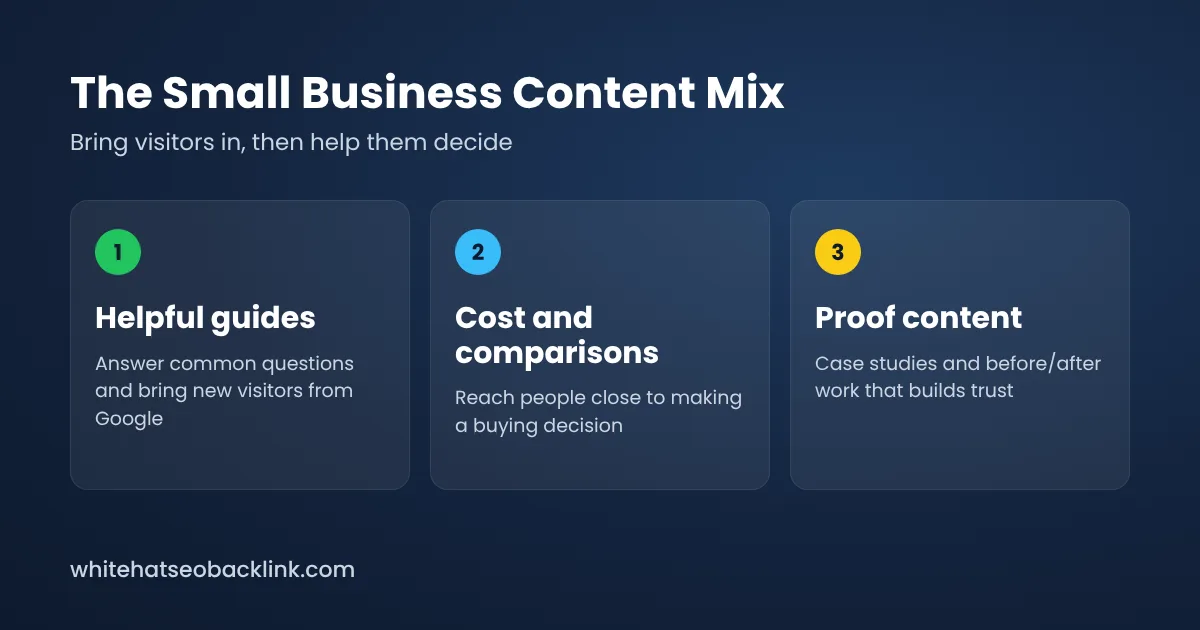
You don’t need every format. Start with three types:
| Content type | Example for a local cleaning company | Job it does |
|---|---|---|
| Helpful guides | “How to remove limescale from shower glass” | Brings new visitors from Google |
| Comparison and cost content | “End of tenancy cleaning cost in Bristol” | Attracts people close to buying |
| Proof content | “Before and after: deep clean of a 3-bed rental” | Builds trust and helps close the sale |
Aim for roughly half helpful guides and half content closer to a buying decision. Pure “tips” content brings traffic but often few customers.
Step 4: Build a 4-hour weekly routine
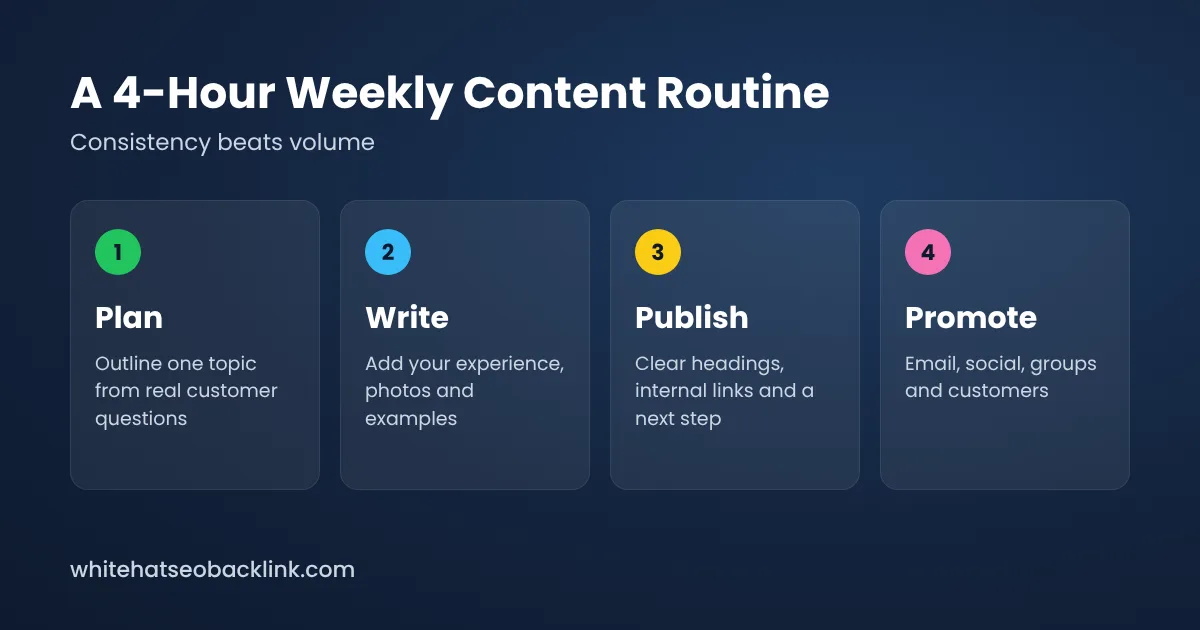
Consistency beats volume. Here’s a routine that works for most owners:
| Time | Task |
|---|---|
| Hour 1 | Outline one article from your topic list, with the main questions it must answer |
| Hours 2 and 3 | Write and add photos, examples or a short checklist |
| Hour 4 | Publish, share it, send it to your email list and update an older post |
That’s one solid article a week, or about 50 a year. Even two good articles a month is enough to see progress if they target the right topics.
Step 5: Write content people actually read
A few habits make a big difference:
- Answer the question in the first paragraph. Then explain the details.
- Use your own experience. Prices you’ve seen, mistakes customers make, photos from real jobs. This is what generic AI content can’t copy.
- Write short sentences and short paragraphs. Most people read on their phone.
- Use clear headings that match the questions people ask.
- Add one clear next step at the end: call, book, get a quote or read a related guide.
Google’s own guidance on creating helpful, people-first content is worth reading once. In short: write for people first, show real expertise and don’t write just to rank.
Step 6: Make sure your website can rank
Great content on a slow, messy website struggles. Before you publish a lot, check the basics:
- Pages load fast on mobile.
- Each page targets one clear topic, so your pages don’t compete with each other.
- Related posts link to each other and to your service pages.
- Google can crawl and index your pages.
Our technical SEO checklist and guide to SEO friendly website design cover these in detail.
Step 7: Promote every piece (don’t just publish)
Publishing is only half the work. Each time you post:
- Share it on the one or two social platforms your customers really use.
- Send it to your email list with a short personal note.
- Use it to answer questions in Facebook groups, forums or Google Business Profile posts.
- Send it to customers who asked that exact question.
- Reach out to related businesses or bloggers who might find it useful.
Over time, strong content also earns backlinks, which helps your whole site rank. Our off-page SEO checklist explains how to build that authority beyond your website.
Step 8: Measure what matters
Ignore vanity numbers at first. Track these monthly:
- Organic visitors to your blog (Google Analytics or Search Console).
- Search queries and impressions for your posts in Search Console.
- Leads from content: calls, forms and emails that mention or came from an article.
- Top posts: which topics bring visitors who actually contact you.
Most new content takes a few months to rank. Don’t judge a post after two weeks. Review after three to six months, then update the winners and improve or merge the weak ones.
Common small business content mistakes
- Writing about your company instead of your customer’s problems.
- Picking topics with huge competition instead of long-tail questions.
- Publishing a burst of ten posts, then nothing for six months.
- Copying competitors’ articles instead of adding your own experience.
- Never updating old posts that are close to page one.
Final thoughts
Content marketing for small business works best when it’s simple: know your customer, answer their real questions, publish on a steady schedule and promote every piece. Four focused hours a week will beat a big plan you never start.
Want your content to rank faster? Strong, relevant backlinks help new posts get noticed. See our link building packages or contact us to talk about a plan for your site.
Frequently asked questions
How much should a small business spend on content marketing?
It depends on your goals and whether you write it yourself. Many small businesses start by investing time instead of money, then pay for writing, design or link building once they see which topics bring leads.
How often should a small business blog?
Once a week is a great target. Twice a month can still work if each post is useful and well promoted. Consistency matters more than volume.
How long does content marketing take to work?
Most businesses see early signs within three to six months, and stronger results over a year. Long-tail topics and good internal linking can speed this up.
Can I use AI to write my content?
AI can help with outlines and first drafts, but add your own experience, examples, prices and photos. Content that sounds generic is unlikely to stand out or win customers.