GEO vs SEO: Key Differences and Where AEO Fits (2026)
Every few months a new acronym shows up in marketing feeds, and right now it’s GEO. Some people say generative engine optimization will replace SEO. Others say it’s the same old work with a new label. Both camps are partly right, which is exactly why the GEO vs SEO question confuses so many site owners.
This guide clears up the GEO vs SEO confusion. You’ll see what each term really means, where AEO (answer engine optimization) fits, the key differences and overlaps, how to measure each one, and how to build a single page that performs in Google, in featured answers and inside AI tools like ChatGPT, Gemini and Perplexity.
Key takeaways
- GEO vs SEO is not either/or: SEO earns rankings, AEO earns answer boxes and GEO earns mentions in AI answers.
- Most AI tools pull from search indexes, so a strong SEO foundation is what makes GEO possible.
- The biggest GEO vs SEO differences are prompts vs keywords, passages vs pages and mentions vs links.
- Track AI mentions, citations and AI referral traffic next to your usual SEO KPIs.
- One answer-first, well-structured page can win in search results, answer boxes and AI tools.
GEO vs SEO vs AEO: quick definitions
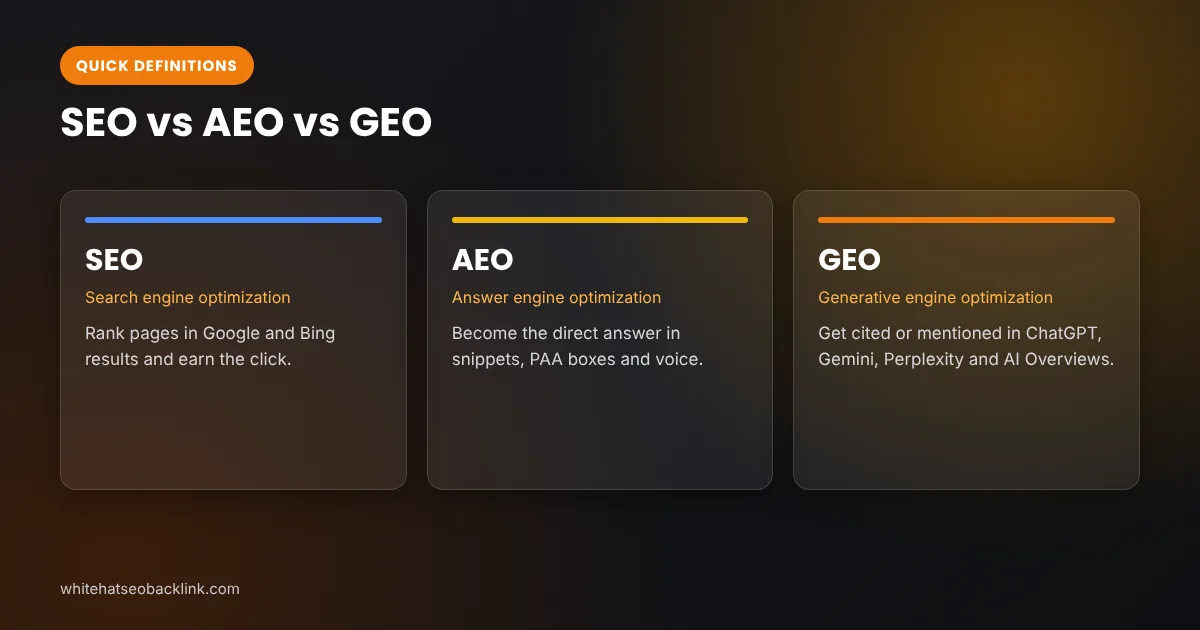
SEO (search engine optimization) is the work of helping your pages rank in traditional search results, so people click through to your site. The goal is a high position and organic traffic.
GEO (generative engine optimization) is the work of getting your brand and content used, mentioned or cited when AI systems write an answer. Think ChatGPT, Gemini, Claude, Perplexity, Google AI Overviews and AI Mode. The goal is to be part of the generated answer.
AEO (answer engine optimization) is the work of shaping content so it can be pulled out as a direct answer: featured snippets, People Also Ask boxes, voice assistants and short AI responses. The goal is to be the answer, often without a click.
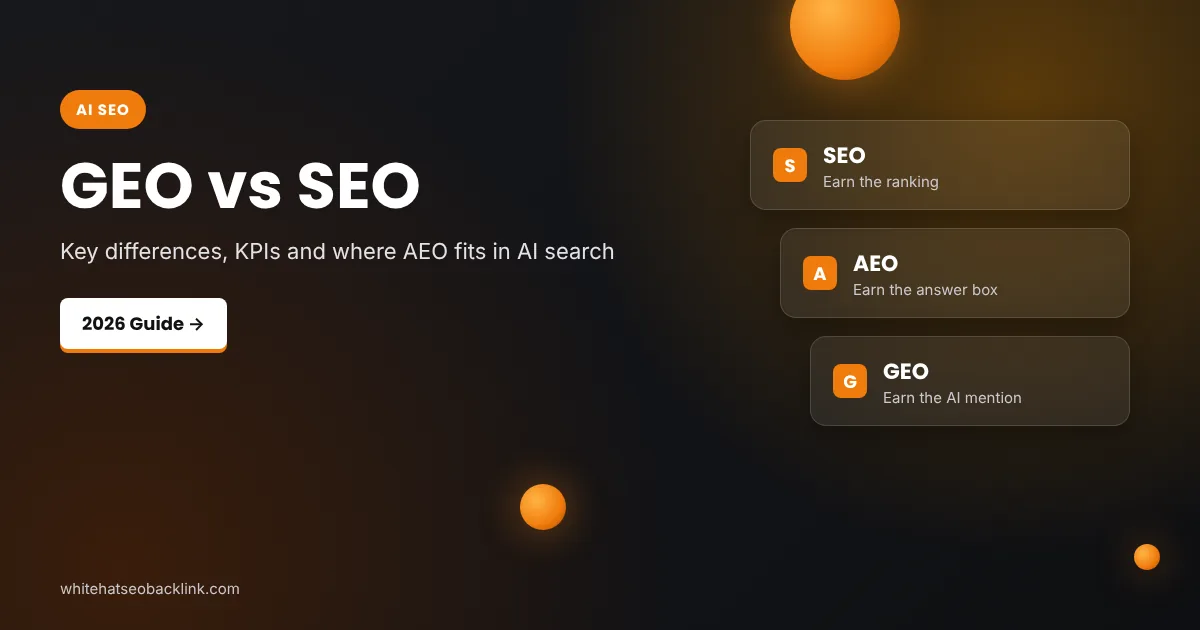
A simple way to remember the GEO vs SEO vs AEO split: SEO earns the ranking, AEO earns the answer box, and GEO earns the mention inside an AI response.
GEO vs SEO vs AEO comparison table
Here is how the three approaches line up side by side:
|
Factor |
SEO |
AEO |
GEO |
|---|---|---|---|
|
Main goal |
Rank and earn clicks |
Be the direct answer |
Be cited or mentioned in AI answers |
|
Where it shows |
Google and Bing results |
Featured snippets, PAA, voice |
ChatGPT, Gemini, Perplexity, AI Overviews |
|
User input |
Short keywords |
Questions |
Long, conversational prompts |
|
Unit of success |
A page |
A passage |
A brand, fact or passage |
|
Key signals |
Relevance, links, experience, technical health |
Clear question-and-answer formatting |
Clear facts, entity consistency, mentions across the web |
|
Main KPI |
Rankings, clicks, conversions |
Snippet wins, PAA presence |
Citations, mentions, share of voice in AI |
|
Click behavior |
Click to your site |
Often zero-click |
Few clicks, but high-intent ones |
GEO vs SEO: how they are similar
Before getting into the GEO vs SEO differences, it helps to see how much the two share. Most AI systems look things up in a search index before they write, so classic SEO is still the entry ticket. These overlaps matter most:
Crawlable pages
If a bot can’t crawl and index your page, neither Google nor an AI tool can use it.
Clear structure
Descriptive headings, short paragraphs and lists help rankers and AI readers alike.
Helpful content
Both reward pages that answer the real question better than anyone else.
Backlinks and mentions
Being referenced by trusted sites builds authority for both.
Trust signals
Expert authors, accurate facts and a solid reputation help in both places.
Search intent
Matching what the person actually wants is still the core skill.
GEO vs SEO: 6 key differences
The overlap is big, but the GEO vs SEO differences change how you plan, write and report. These are the six that matter in practice.
1. Keywords vs prompts
SEO starts with keywords: short phrases with known search volume. GEO starts with prompts, which are longer and more personal, such as “which SEO agency is best for a small law firm on a tight budget?” You can’t pull exact prompt volumes the way you pull keyword volumes, so GEO research leans on customer questions, sales calls, forums and the follow-up questions AI tools suggest.
2. Ranked list vs written answer
Google shows a list and lets the user choose. An AI tool reads several sources, combines them and writes one answer. In SEO you compete for a position. In GEO you compete to be one of the few sources the model trusts enough to use, so being quoted matters more than being “number one.”
3. Pages vs passages and facts
SEO judges the whole page. Generative engines often lift a single passage, a statistic or a definition. A page can rank on page two and still be cited if one section answers a question more clearly than the page-one results do. That’s why self-contained sections with a direct answer up top work so well for GEO.
4. Links vs mentions
Backlinks remain a core SEO signal. For GEO, unlinked brand mentions on reviews, forums, comparison lists and news sites also shape what models “know” about you. If the web consistently describes your brand as an expert in a topic, AI tools are more likely to repeat that.
5. One engine vs many models
SEO mostly means Google, with Bing in second place. GEO spans several models that use different indexes and favor different sources. One tool might lean on Reddit threads while another prefers established publishers. Results also vary from one run to the next, so GEO results are less stable than rankings.
6. Clicks vs visibility
This is the GEO vs SEO difference most reports miss. SEO success is easy to see in Search Console: impressions, clicks and positions. GEO success is often a mention with no click at all. The visitors who do click through from AI answers tend to arrive further along in their decision, which is why the traffic can be small but valuable.

Where AEO fits in the GEO vs SEO debate
AEO is the bridge. It grew out of SEO when Google started showing featured snippets and voice answers, and its core habit, answering a clear question in a clear, short block, is exactly what generative engines like to quote. If you already format content for snippets, you’re halfway to GEO.
In practice, most teams don’t need three separate strategies. They need one SEO foundation, with AEO formatting on every key page and GEO work layered on top: brand mentions, original data and checking how AI tools describe them.
GEO vs SEO KPIs: how to measure each
Measurement is where the GEO vs SEO gap is widest. Track both sets of metrics side by side, because a drop in clicks can hide a rise in AI visibility, and the other way around.
|
Goal |
SEO KPI |
GEO KPI |
Where to check |
|---|---|---|---|
|
Visibility |
Impressions and average position |
How often your brand appears in AI answers for your core prompts |
Search Console; manual prompt tests or AI visibility trackers |
|
Authority |
Referring domains |
Citations of your URLs in AI answers |
Ahrefs or similar; Perplexity and AI Overview source lists |
|
Share of voice |
Ranking share for a keyword set |
Your mentions vs competitors’ mentions across the same prompts |
Rank tracker; prompt tracking sheet |
|
Traffic |
Organic clicks |
Referral sessions from chatgpt.com, perplexity.ai and similar |
GA4 referral report |
|
Accuracy |
Correct title and snippet |
Whether AI describes your brand, prices and services correctly |
Manual review each month |
|
Business impact |
Organic leads and sales |
Leads that mention finding you through an AI tool |
CRM and a “how did you hear about us?” field |
Tip: build a fixed list of 20 to 30 prompts that real buyers would ask, run them in the main AI tools once a month, and log whether you’re mentioned, cited or missing. It’s simple, but it turns GEO from guesswork into a trend you can report.

How to optimize one page for SEO, AEO and GEO
You don’t have to pick a side in GEO vs SEO, and you don’t need separate pages for each channel. One well-built page can rank, win the snippet and get cited. Use this checklist when you write or update a key page:
- Nail the SEO basics. One focus keyword, a matching title and H1, a clean URL, fast load time and solid internal links.
- Answer first. Open each key section with a one- or two-sentence answer, then add detail. This serves snippets and AI extraction at the same time.
- Use question headings where they fit. Headings that mirror real questions make passages easy to match to prompts.
- Add facts worth quoting. Specific numbers, definitions, steps and comparisons are what models lift. Vague claims get skipped.
- Show real experience. Original data, screenshots, examples and named authors make your page different from the hundred others the model has read.
- Keep entities consistent. Use the same brand name, service names and descriptions on your site, social profiles and directories.
- Add structured data that fits. Article, FAQ, HowTo, Product or Organization schema helps machines read the page correctly.
- Earn mentions beyond your site. Guest posts, digital PR, reviews and helpful forum answers spread your name in the places AI tools read.
- Keep it fresh. Update facts and dates on a schedule. Outdated pages lose both rankings and citations.
For the full step-by-step plan, see our AI SEO strategy guide. If Google’s AI features are your main focus, read how to show up in AI Overviews, and for chat assistants, our guides on how to rank in ChatGPT and Perplexity SEO.
GEO vs SEO: which should you prioritize?
For almost every business the honest answer is “SEO first, GEO alongside.” Without indexable, trusted pages there is nothing for AI tools to find. That said, the right balance depends on how your buyers search:
|
Business type |
Suggested focus |
Why |
|---|---|---|
|
Local service business |
Mostly SEO, light GEO |
Map results, reviews and local pages still drive most calls |
|
E-commerce store |
SEO plus AEO |
Product and category rankings convert; snippets help with buying questions |
|
B2B or SaaS company |
SEO plus strong GEO |
Buyers research long, complex questions in AI tools before contacting sales |
|
Publisher or blog |
SEO plus AEO |
Traffic is the business model, so clicks still matter most |
|
Agency or consultant |
Balanced SEO and GEO |
Prospects ask AI tools for recommendations and shortlists |
A practical starting split for many sites is roughly 70% of effort on SEO and AEO foundations and 30% on GEO activities. Adjust it as your prompt tracking and referral data show where your buyers actually come from.
Common GEO vs SEO myths to ignore
- “SEO is dead.” AI tools still retrieve pages from search indexes. Weak SEO usually means weak GEO.
- “You need special AI-only content.” You need clear, useful content. Writing robotic text “for the AI” usually hurts both humans and rankings.
- “An llms.txt file will get you cited.” It may help some tools read your site, but it is not a ranking switch. Read what llms.txt is before you rely on it.
- “Someone can guarantee AI citations.” No one controls how models answer. Be wary of anyone who promises fixed placements.
GEO vs SEO FAQs
Final thoughts
The GEO vs SEO debate is less of a battle than it looks. SEO gets you found, AEO gets you quoted, and GEO gets you recommended. Build strong, crawlable pages first, format them so answers are easy to lift, and then grow your brand’s presence in the places AI tools read. Treat GEO vs SEO as teamwork, not a contest. Do all three together and you won’t have to guess which kind of search wins next year.
Not sure how to balance GEO vs SEO?
We build SEO foundations that also earn mentions in AI answers, and we report on both so you can see what is working.