LLM SEO: How to Get Your Brand Cited in AI Answers (2026 Guide)
People no longer only “Google it.” They ask ChatGPT, Gemini, Claude or Perplexity, and they get one tidy answer with a handful of brands named inside it. If your business is not one of those names, you are invisible in a growing share of searches.
That is what LLM SEO fixes. In this guide you will learn what it is, how large language models actually choose sources, and a simple 9-step plan you can start this week. No hype, no magic prompts, just the work that moves the needle.
What is LLM SEO?
LLM SEO is the practice of making your brand, pages and facts easy for large language models to find, understand and repeat in their answers. A large language model (LLM) is the engine behind tools like ChatGPT, Gemini and Claude.
Classic SEO is about ranking a blue link. LLM SEO is about being the source an AI trusts enough to mention, quote or link. You will also see it called generative engine optimization (GEO), answer engine optimization (AEO) or AI search optimization. The names differ, but the goal is the same: show up inside the answer, not just below it.
How LLMs decide which brands to mention
Most guides skip this part, yet it is the key to everything else. An AI assistant pulls information from two places:
- Training data. Everything the model learned before its cut-off date. If your brand was discussed widely across the web, the model “remembers” you.
- Live retrieval. When a tool browses the web in real time (often called RAG, or retrieval-augmented generation), it runs searches, reads a few pages and summarises them. ChatGPT search leans heavily on Bing, Gemini uses Google, and Perplexity runs its own index plus partners.
So a good strategy works on both fronts. You earn mentions across the web so models learn about you over time, and you publish clear, crawlable pages so retrieval systems can grab your answer today.
Signals that make a source “quotable”
- Clear, direct answers near the top of a section
- Consistent facts about your brand across many sites
- Freshness, with visible “last updated” dates
- Authority, meaning links and mentions from trusted sites
- Easy structure with headings, lists and tables that are simple to lift
LLM SEO vs traditional SEO
The two overlap far more than people think. Here is a quick comparison.
| Factor | Traditional SEO | LLM SEO |
|---|---|---|
| Main goal | Rank a page in the top 10 | Get cited or named in an AI answer |
| Key unit | The whole page | A short passage or fact |
| Brand mentions | Helpful | Critical, even without links |
| Measurement | Rankings and clicks | Share of AI answers and referrals |
| Technical base | Crawlable, fast pages | Same, plus open access for AI bots |
The good news is that strong SEO is still the foundation. Pages that rank well in Google and Bing are much more likely to be retrieved, so do not throw away what already works.
9 steps to do LLM SEO the right way
1. Make sure AI crawlers can reach your site
Check your robots.txt file and firewall. Bots like GPTBot, OAI-SearchBot, ClaudeBot, PerplexityBot and Google-Extended should not be blocked unless you have a clear reason. Many sites block them by accident through a security plugin or CDN setting. If you want to go further, you can also add an llms.txt file as a simple map of your best pages.
2. Get indexed in Bing, not only Google
This is a gap almost every competitor misses. ChatGPT search relies largely on Bing results, so a site that is invisible in Bing is often invisible in ChatGPT too. Verify your site in Bing Webmaster Tools, submit your sitemap and turn on IndexNow so new pages are picked up fast.
3. Write answer-first content
Put the direct answer in the first one or two sentences under each heading, then expand. Language models love passages that stand on their own. A good test: if someone copied only that paragraph, would it still make sense? If yes, it is quotable.
4. Break pages into clean “chunks”
Retrieval systems split pages into small pieces before choosing what to use. Use descriptive H2 and H3 headings, short paragraphs, bullet lists and tables. Avoid hiding key facts in images, tabs or long walls of text.

5. Build entity clarity around your brand
An entity is a “thing” a model can recognise, such as your company, founder or product. Keep your name, description, address and services identical everywhere: your site, Google Business Profile, LinkedIn, Crunchbase, directories and social profiles. Add Organization and Person schema to your site so machines can connect the dots.
6. Earn brand mentions, not just backlinks
For LLM SEO, an unlinked mention in a respected publication still teaches the model that your brand belongs in a topic. Digital PR, podcast guest spots, expert quotes, original surveys and reviews on trusted platforms all help. Reddit, Quora and industry forums are cited heavily in AI answers, so take part in honest, helpful ways.
7. Publish original data and opinions
Models repeat what is unique. If ten blogs say the same thing, the AI only needs one of them. If you publish your own survey, benchmark or case study with real numbers, you become the only source for that fact. That is the fastest route to citations.
8. Keep content fresh and dated
AI tools prefer recent information, especially for “best”, “pricing” and “how to” questions. Review your key pages every quarter, update numbers and examples, and show a clear “last updated” date.
9. Track your AI visibility
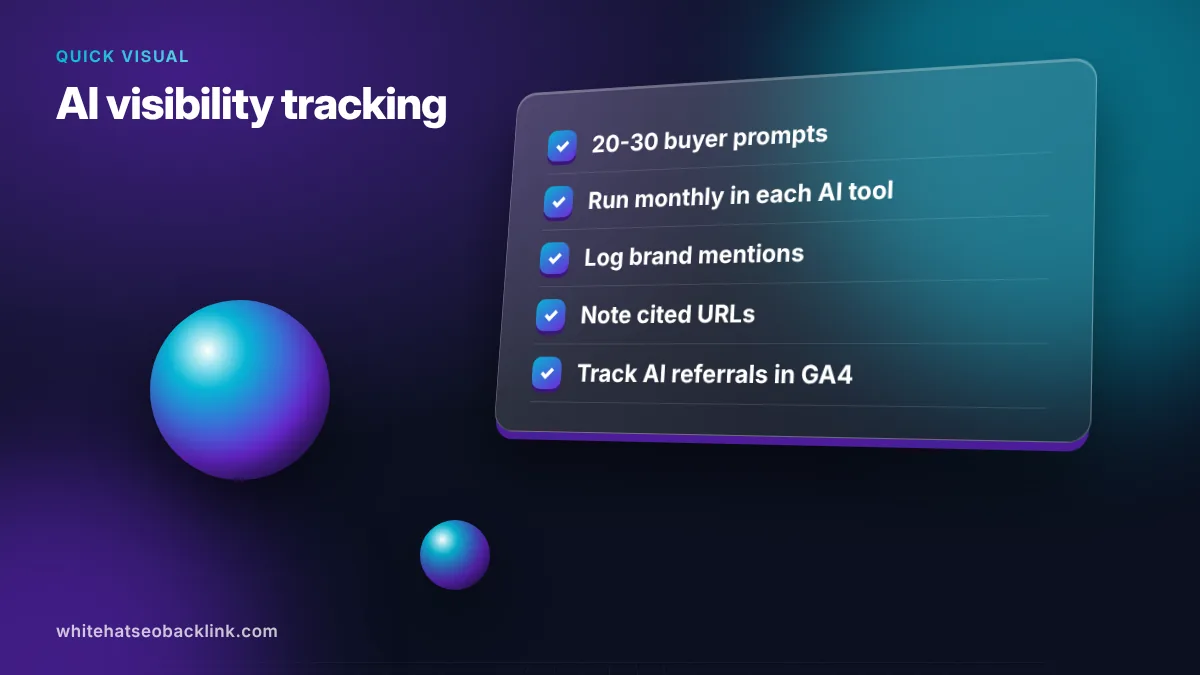
You cannot improve what you do not measure. Start simple:
- Write 20 to 30 prompts your buyers would ask, such as “best white hat link building agency for SaaS.”
- Run them monthly in ChatGPT, Gemini, Perplexity and Claude.
- Record whether your brand appears, which competitors appear and which URLs are cited.
- Check GA4 for referral traffic from chatgpt.com, perplexity.ai and gemini.google.com.
Tools such as Ahrefs Brand Radar, Semrush AI Toolkit and Rank Math’s AI visibility features can automate this as you grow.
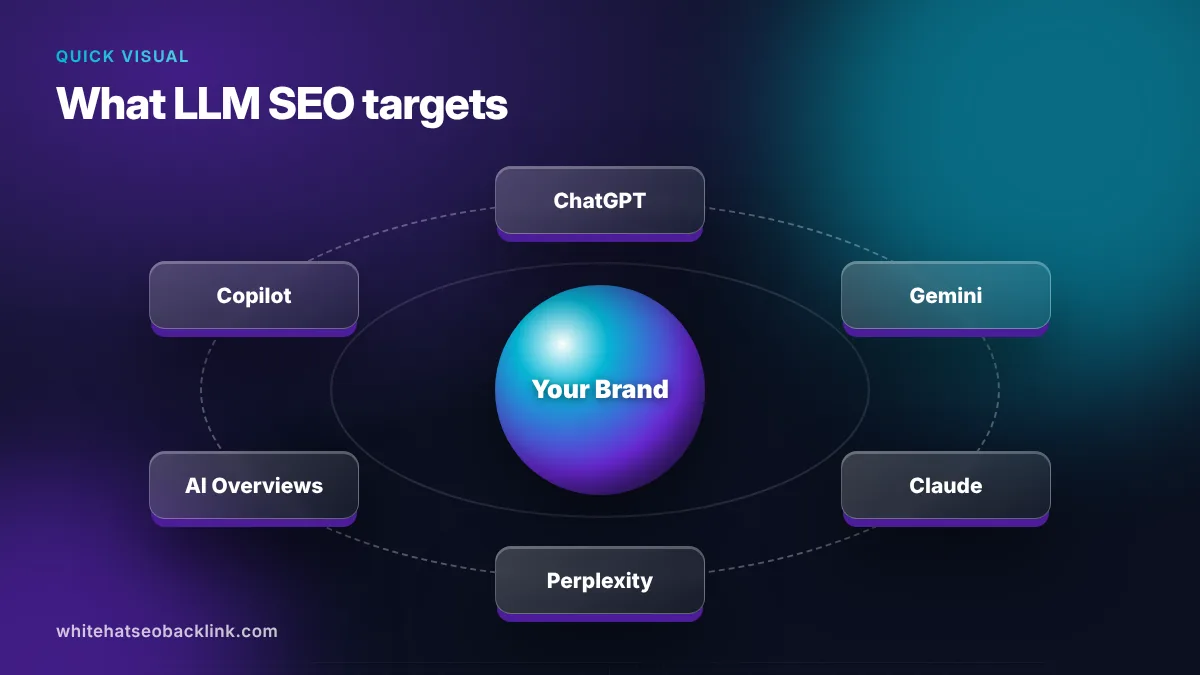
Platform tips: ChatGPT, Gemini, Claude and Perplexity
Each assistant behaves a little differently, so a smart LLM SEO plan adjusts slightly for each one.
- ChatGPT: Bing visibility and strong brand mentions matter most. Our guide on how to rank in ChatGPT goes deeper.
- Gemini and Google AI Overviews: Classic Google rankings, helpful content and schema carry the most weight. See how to show up in AI Overviews.
- Perplexity: Cites sources openly and loves fresh, well-structured pages. Read our Perplexity SEO guide.
- Claude: Uses web search when needed and rewards clear, trustworthy, well-sourced writing.
Common LLM SEO mistakes to avoid
- Blocking AI bots by accident through a CDN or security tool.
- Chasing “AI hacks” like hidden prompts or keyword stuffing. Models are trained to ignore manipulation, and it can hurt trust.
- Inconsistent brand data across profiles, which confuses entity matching.
- Thin, generic content that adds nothing new to the web.
- Ignoring classic SEO. Retrieval still starts with search indexes, so rankings, links and site health still matter.
How long does LLM SEO take to work?
Retrieval-based wins can appear within weeks. Once a page ranks in Bing or Google, tools that browse the web can start citing it almost right away. Training-based visibility is slower, because models only refresh their knowledge every few months. Plan for three to six months of steady work before judging results, much like classic SEO.

FAQs about LLM SEO
Is LLM SEO replacing traditional SEO?
No. LLM SEO builds on top of traditional SEO. Search indexes still feed most AI answers, so rankings, technical health and links remain the base layer.
Do backlinks still matter for AI answers?
Yes. Links help pages rank, and ranked pages get retrieved. Links from trusted sites also send authority signals that models pick up during training.
Can small businesses compete in AI answers?
Absolutely. AI tools often name niche or local experts when their content is the clearest answer to a specific question. Focus on narrow topics you know better than anyone.
What is the best first step for LLM SEO?
Check that AI crawlers are allowed, verify your site in Bing Webmaster Tools, then rewrite your top five pages with answer-first sections. Those three moves give the quickest return.
Final thoughts
LLM SEO is not a trick. It is the same principle that has always worked in search: be the clearest, most trusted answer on the topic, and make it easy for machines to see that. Open your site to AI crawlers, write answer-first content, earn real mentions and track your visibility every month. Do that consistently and your brand will start showing up where your customers are now asking their questions.